


I don’t know any other artist who does something like this these days—working almost live alongside their followers, their audience, the way I have over the past three months since I began this series dedicated to our psychological fragility.
I still don’t have a plan for where this series will be exhibited. I’m in discussions with several galleries and several people, and somehow I feel it has to end up in a truly remarkable place, even if it takes a little time to make it happen.
Until I have a physical gallery in Paris, London, Vienna, Berlin, or New York, I invite you here instead, to my virtual gallery on Romania’s No. 1 Substack, which has just surpassed 310,000 subscribers.
Here I have decided to exhibit, all in one place for you, all 21 paintings from The Daffodil Lament series.
Dolores O’Riordan, a tormented soul with an unmistakable voice, often used music to process her personal traumas. Sadly, she endured more than her share throughout her short life—from childhood, abandonment, and sexual abuse to depression, bipolar disorder, dissociative disorder, schizophrenic tendencies, all intensified by episodes of alcohol and drug abuse.

Dolores shaped my teenage years in the 1990s and, in fact, the souls of millions of people—through her bitter, strange, innocent, and melancholic voice. Many of you know her only through the iconic Zombie, but Dolores was infinitely more than that. She was an emotional multiverse.
The 21 paintings, a reference to the song Twenty One, seek to create an artistic visual projection of the fragility of the human mind—conceptual personifications of mental illnesses, if you will. Have you ever wondered what depression or abandonment might look like? I will show you how I see them throughout these 21 canvases.
Through this artistic exercise, I pay tribute to this exceptional artist as an obsessive reminder of our emotional fragility. Many of us hide it out of shame; many refuse to seek comfort within ourselves or from others. Dolores managed to keep rowing through life for a while thanks to her songs, until her “boat” finally sank in a bathtub in a hotel room.
Over these past months, you have had the chance to watch me at work, to see how I think, and to witness the formation of a coherent, moving, and meaningful artistic project.
Many celebrated artists today choose isolation, a kind of artistic indulgence that I don’t necessarily agree with, although I respect it. I cannot isolate myself from society; curiosity is a flaw I have no intention of giving up.
Let’s dive straight into Dolores’ world together, and I guarantee that by the time you reach the end of these 21 canvases, you will feel everything I felt while creating this series.
1.Empty
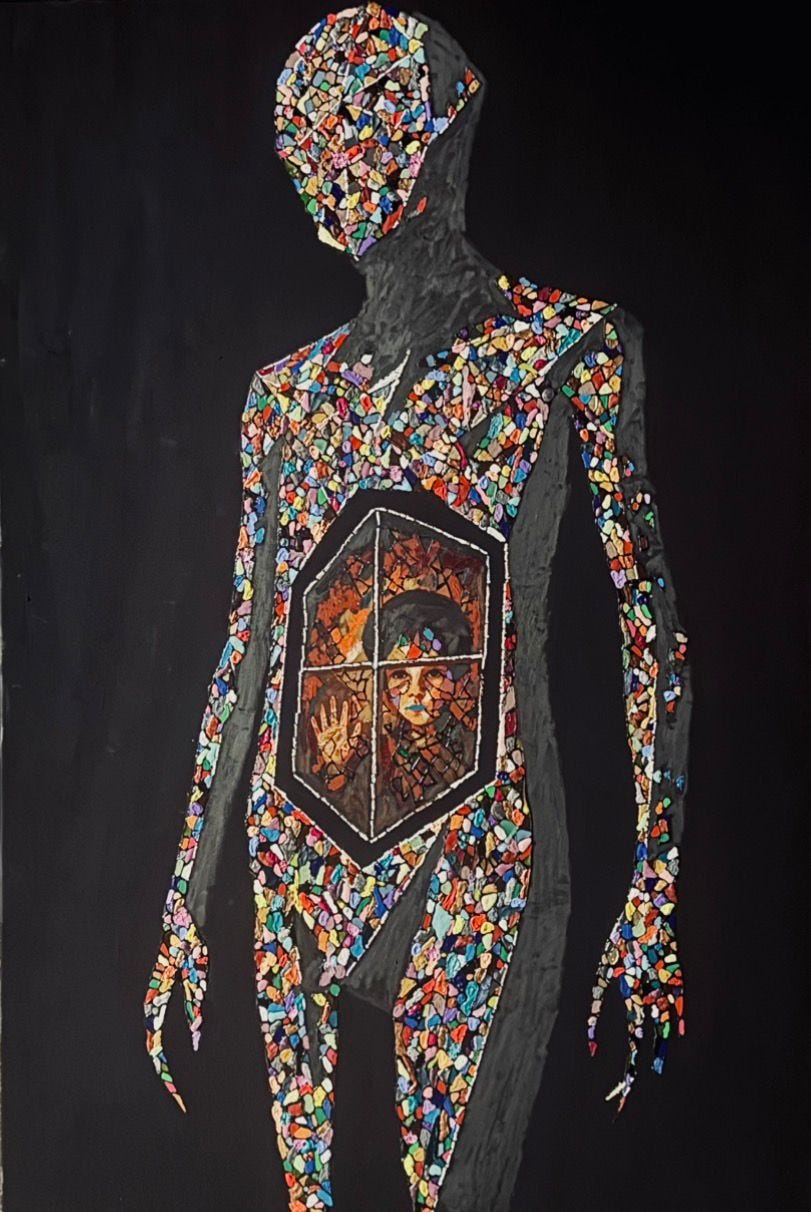
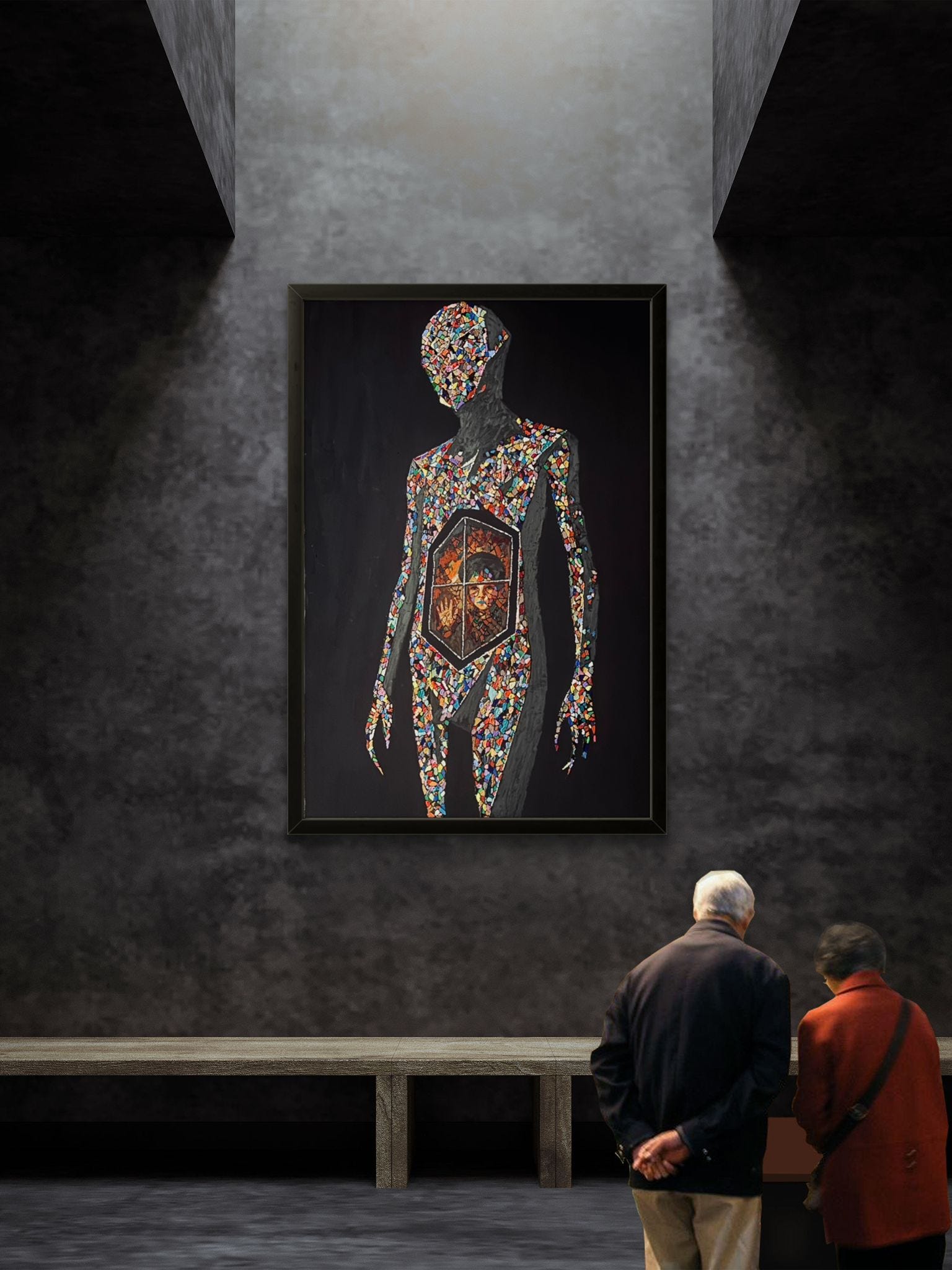
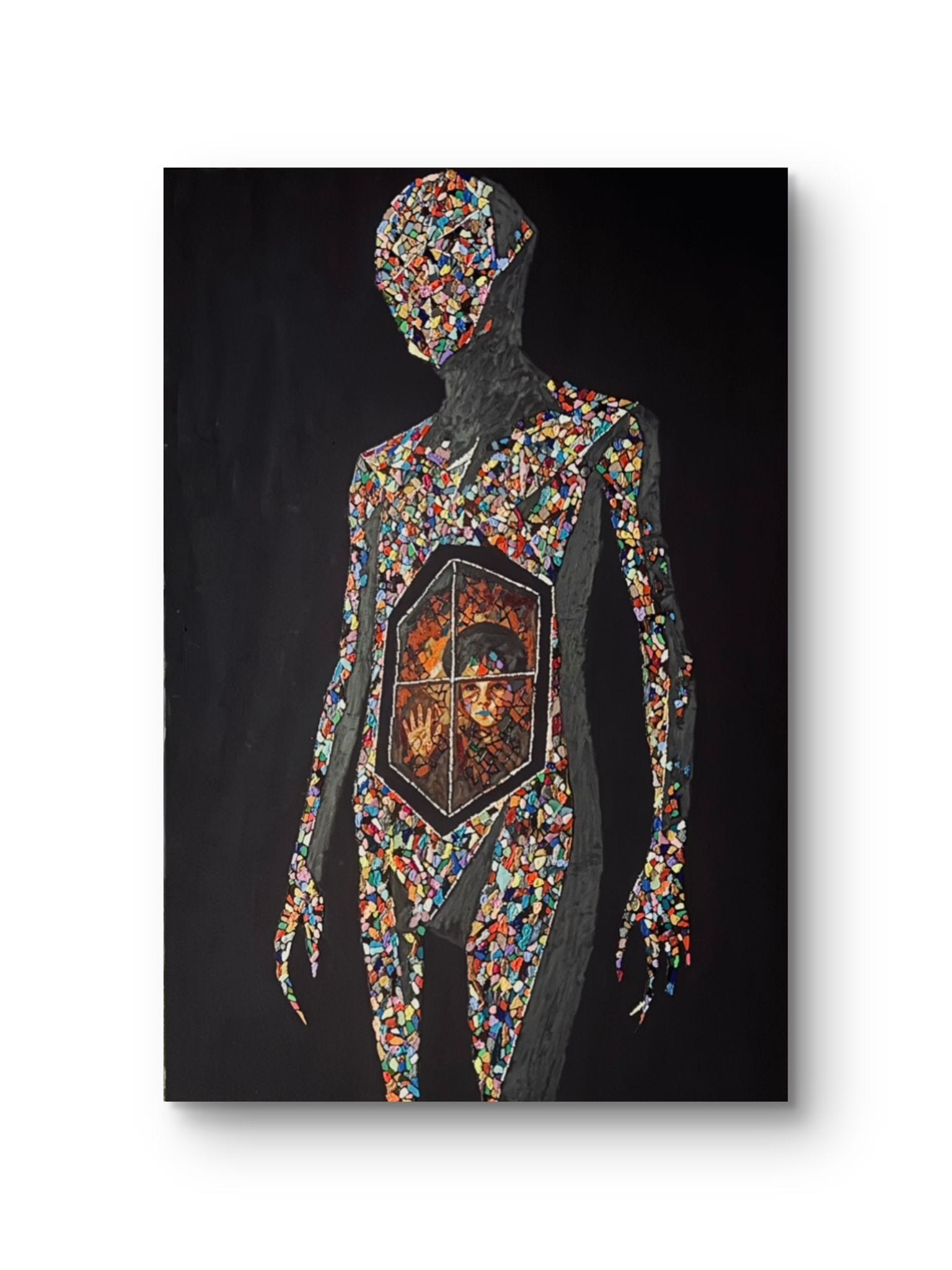
The first canvas in the series is titled Empty and refers to the trauma of sexual abuse. Dolores was the victim of such abuse between the ages of eight and twelve at the hands of a close family friend. In this painting, pain takes the form of colored shards that transform the body into a strange stained-glass window, while inside the body a child remains trapped, as if it can never escape. That’s how many of us are.
2.Linger
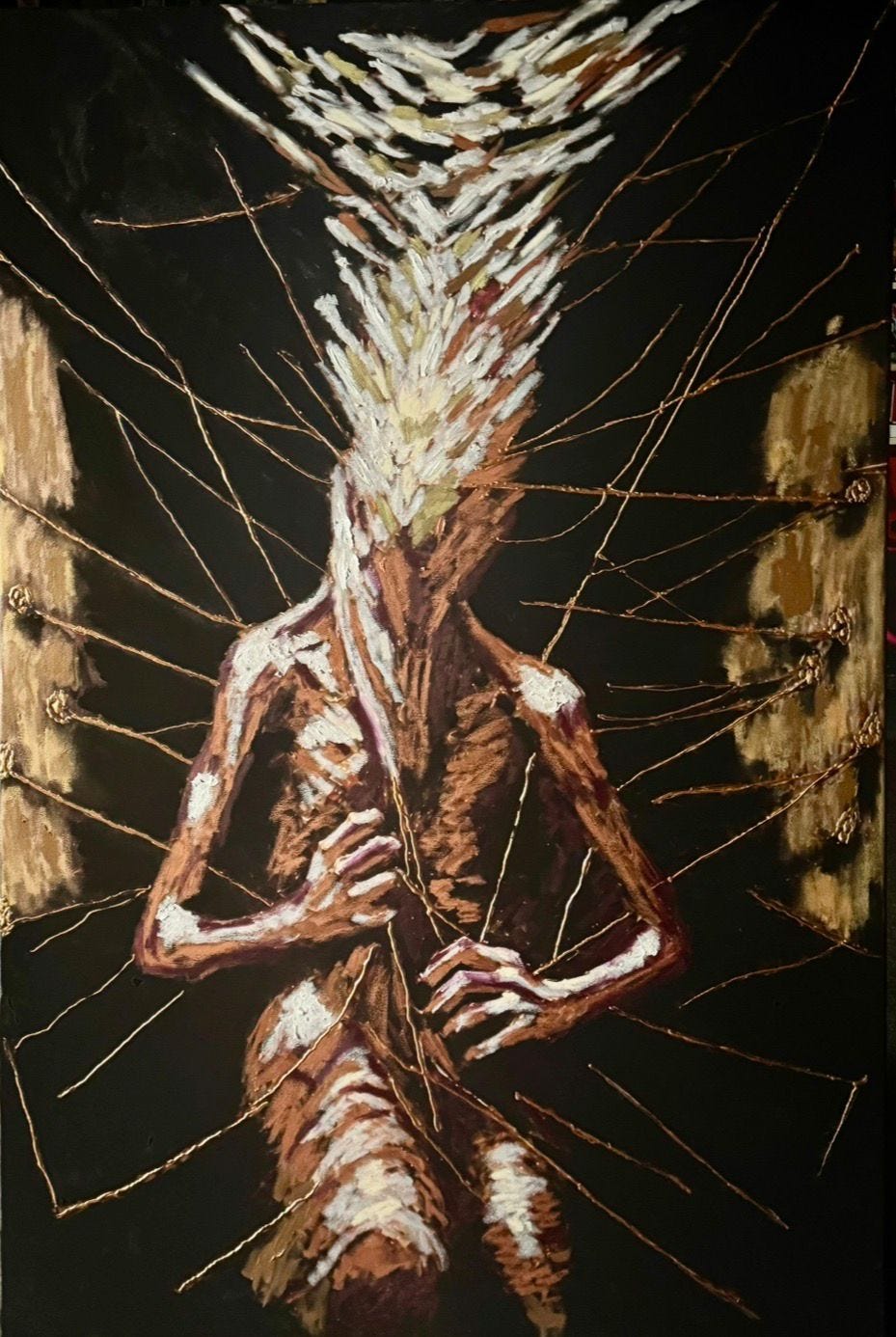
The second canvas is titled Linger, after the song that made The Cranberries famous. It tells the beautiful and heartbreaking story of those who become trapped within themselves, or somewhere in the landscape of their own lives, no longer able to move forward or find happiness. They remain captive to the strings they have tied around themselves—strings woven from excuses and regrets.
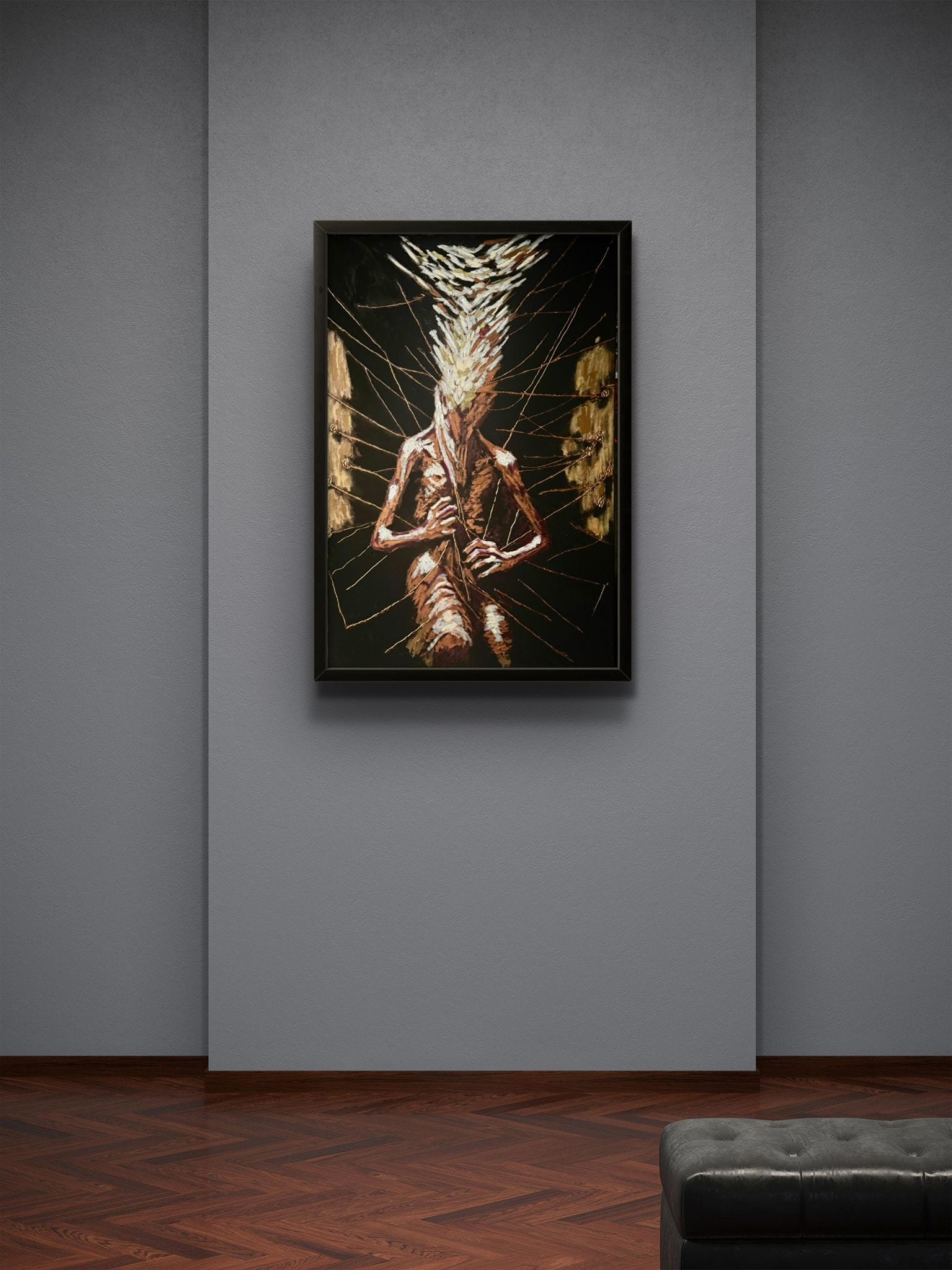
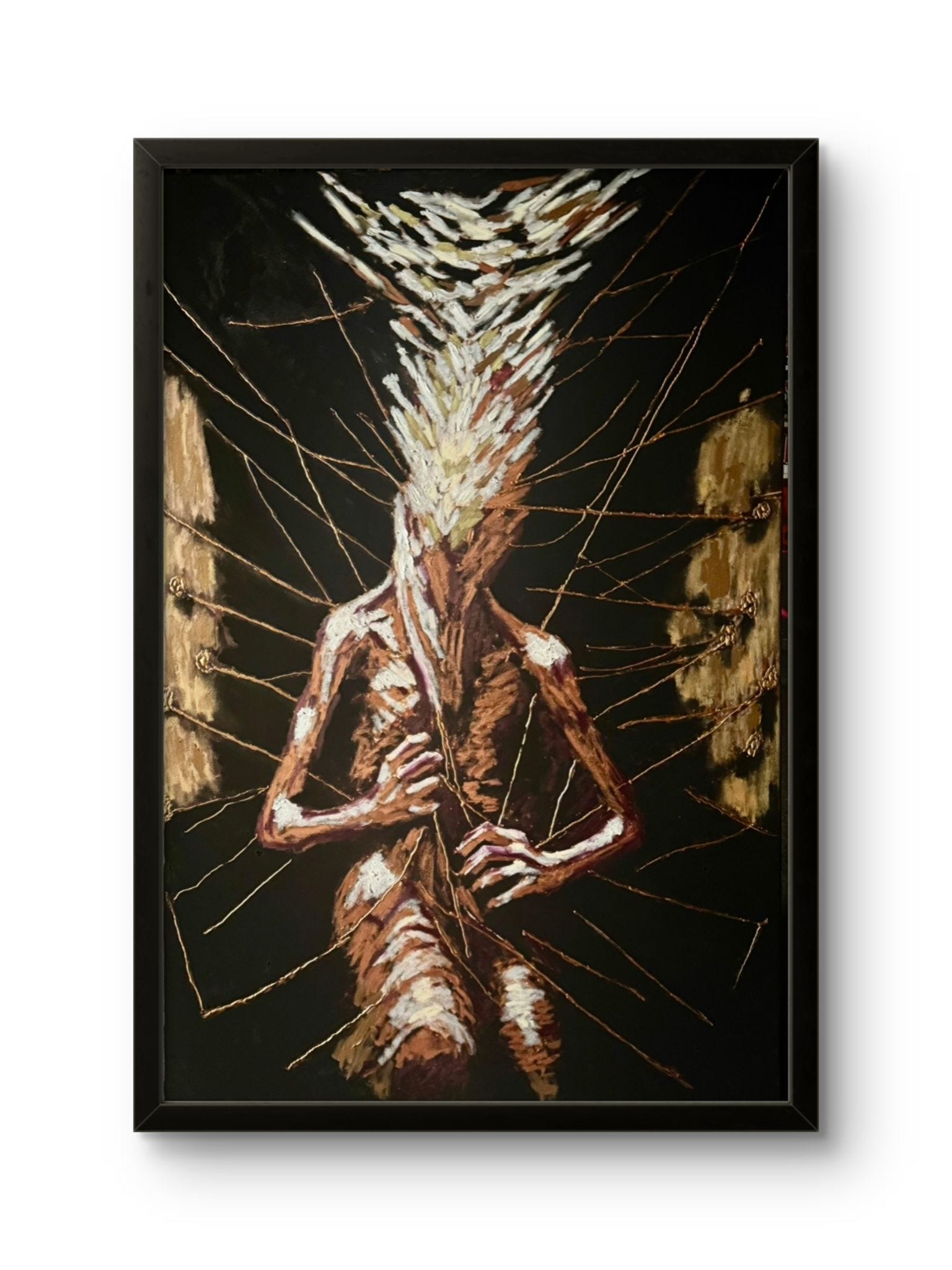
3.Shattered
…is the third of the 21 canvases in The Daffodil Lament series, which I dedicate to Dolores O’Riordan, the late lead singer of the legendary band The Cranberries. As I said at the beginning of this journey, each canvas bears the title of one of her songs, while also reflecting her psychological struggles, traumas, and the emotional suffering that marked her life so profoundly.
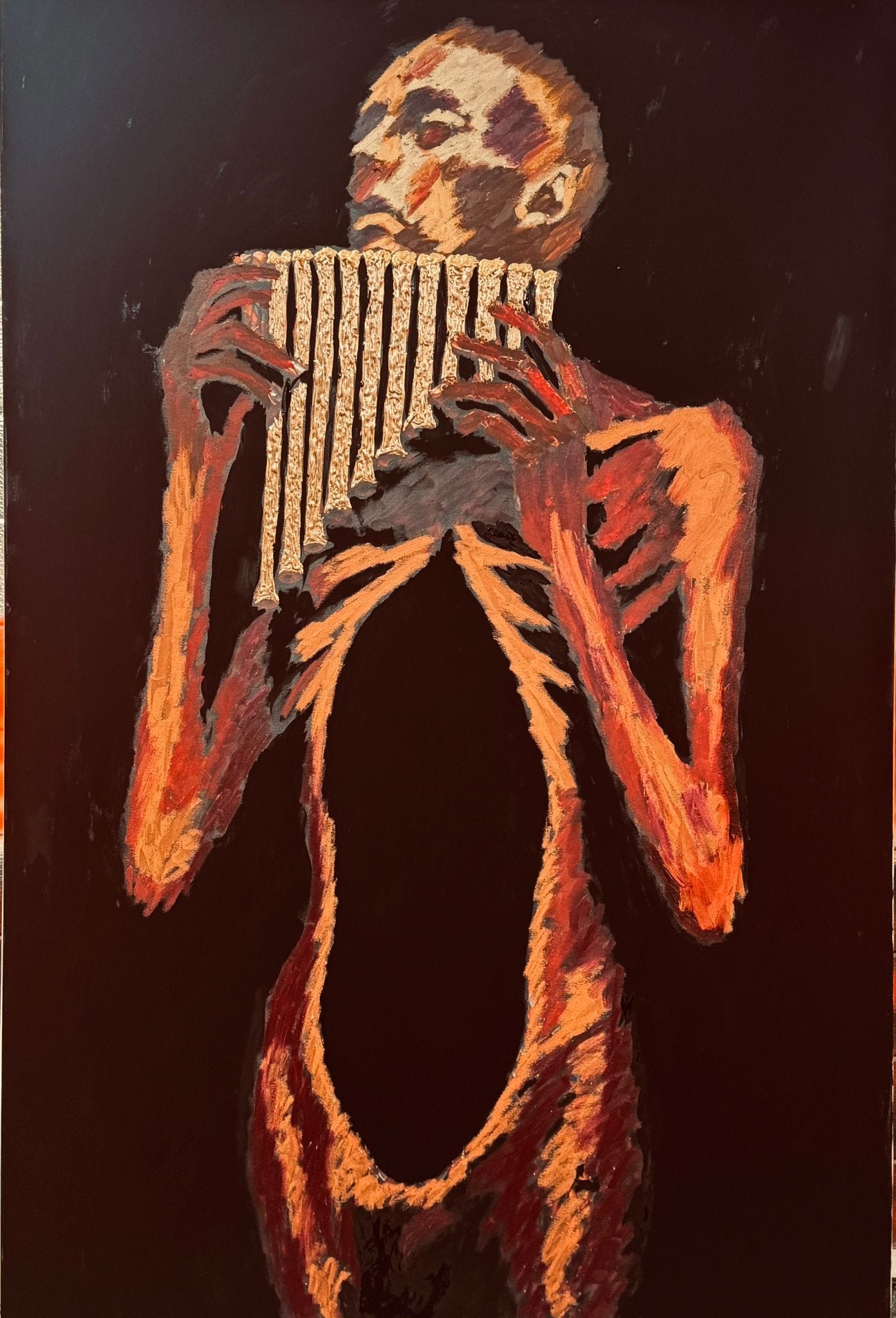
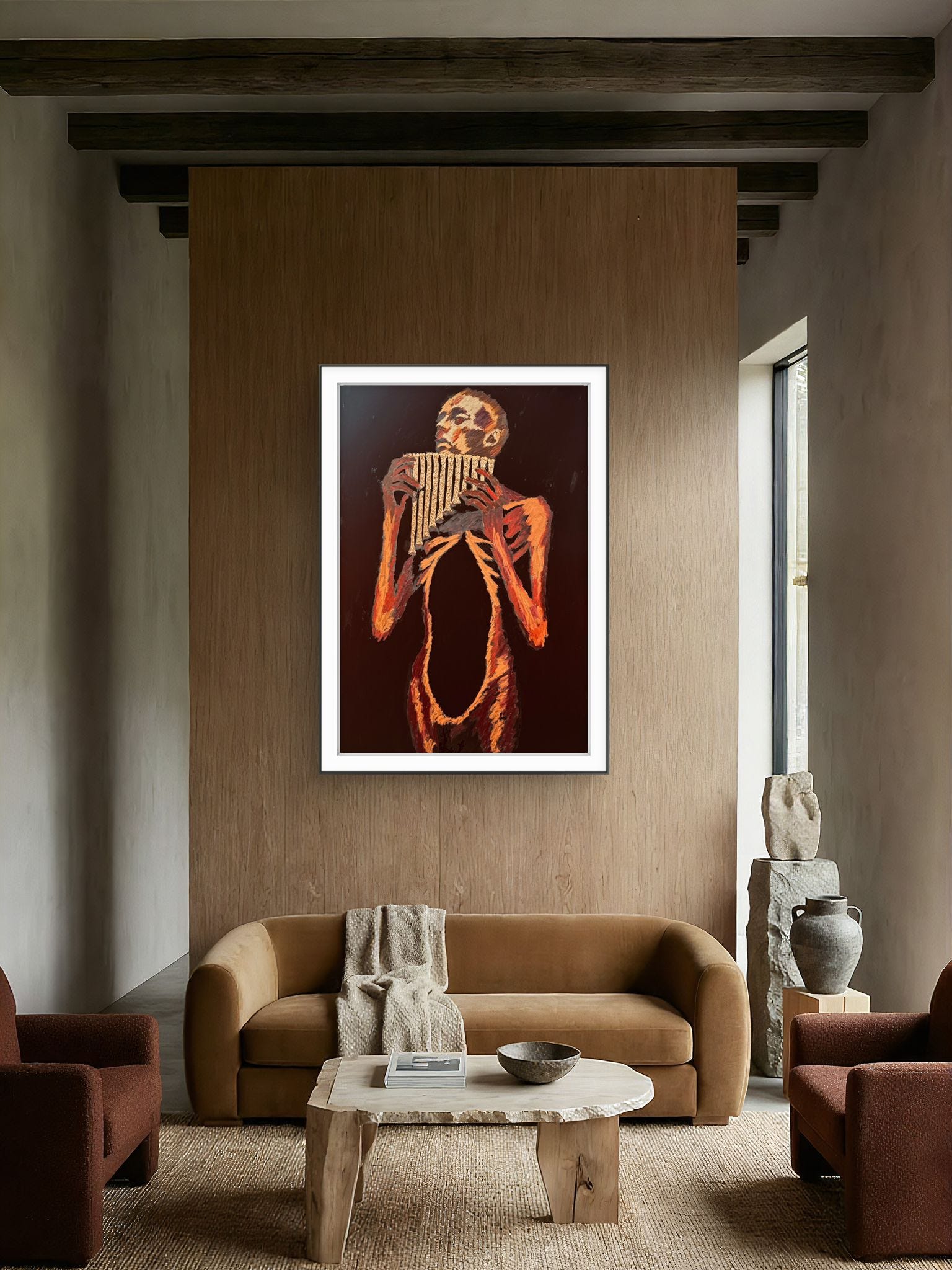
My canvas is deeply unsettling because it also mirrors the visual language of major depression—an inner void, like a vast hole at the core of the self. At the same time, it speaks of the immense sacrifice true artists make for the world. Here, that sacrifice is embodied by a pan flute fashioned from the ribs of the figure in the painting.
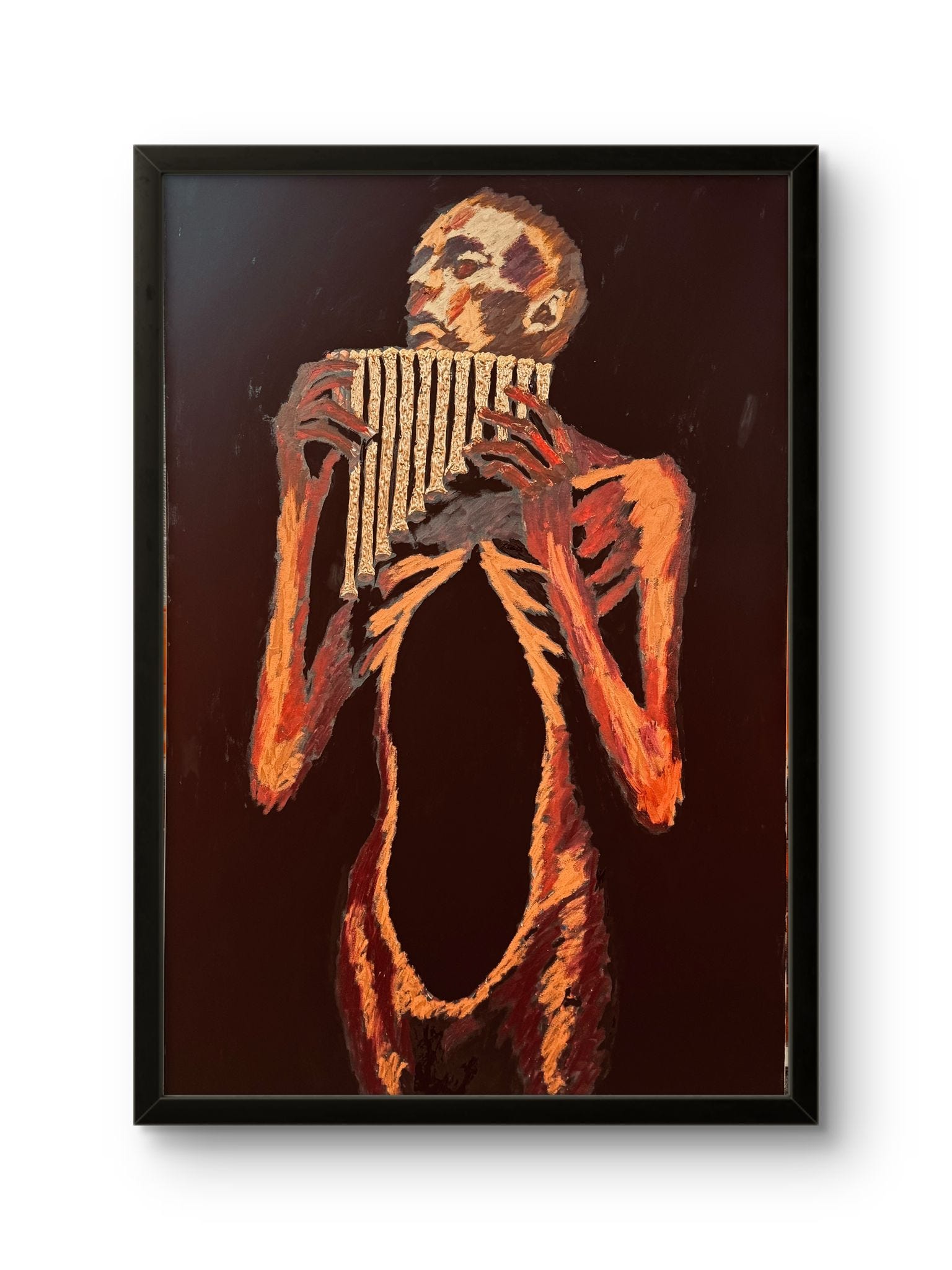
That was Dolores at one point as well—an acoustic shell for her own pain, a resonating chamber crying out through music for the redemptive silence of death.
4.Zombie
The fourth canvas in The Daffodil Lament series is titled Zombie, the most famous song by The Cranberries, widely regarded as a masterpiece of alternative rock. The song was written by Dolores O’Riordan herself after the tragic bombing that claimed the lives of two young Irish children.
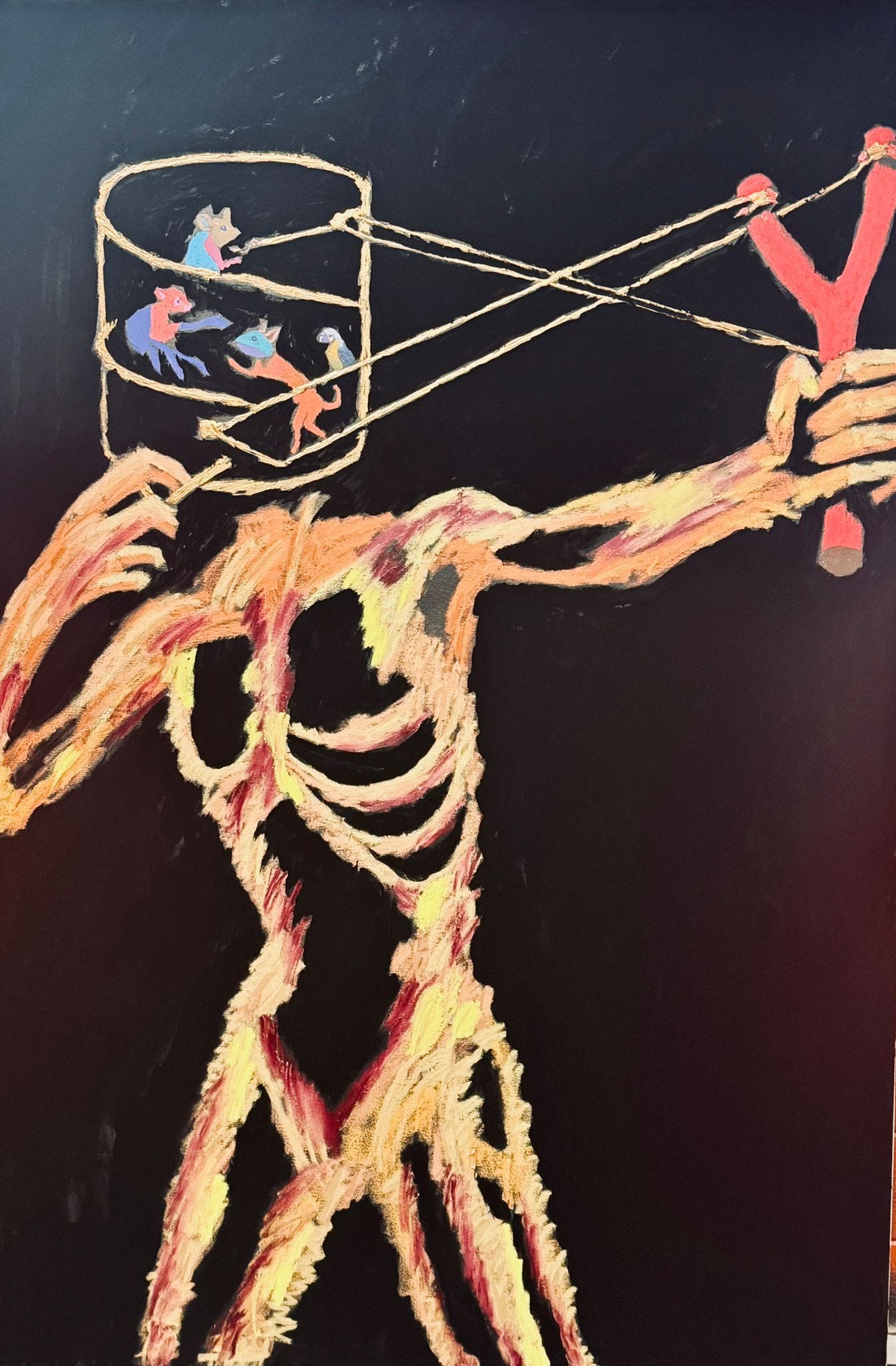
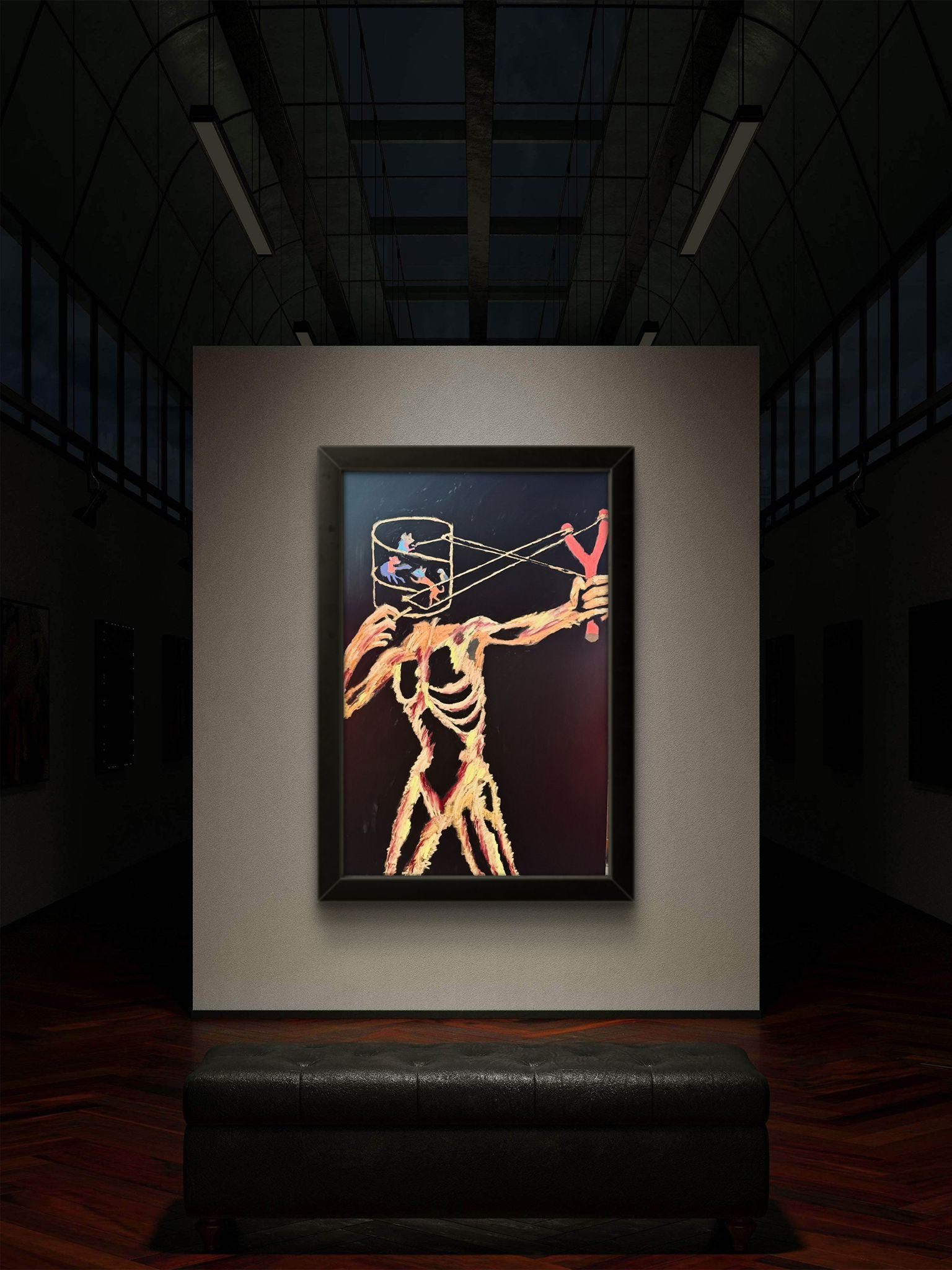
It is a powerful canvas in which I draw heavily on the famous line “in your head” from the chorus, transforming it into the concept of an infrastructure of pain, where everything unfolds inside a head that has become a cage. It is a head that no longer thinks, because demons, ideologies, memories, traumas, and hatred have taken complete control, consuming the body from within.
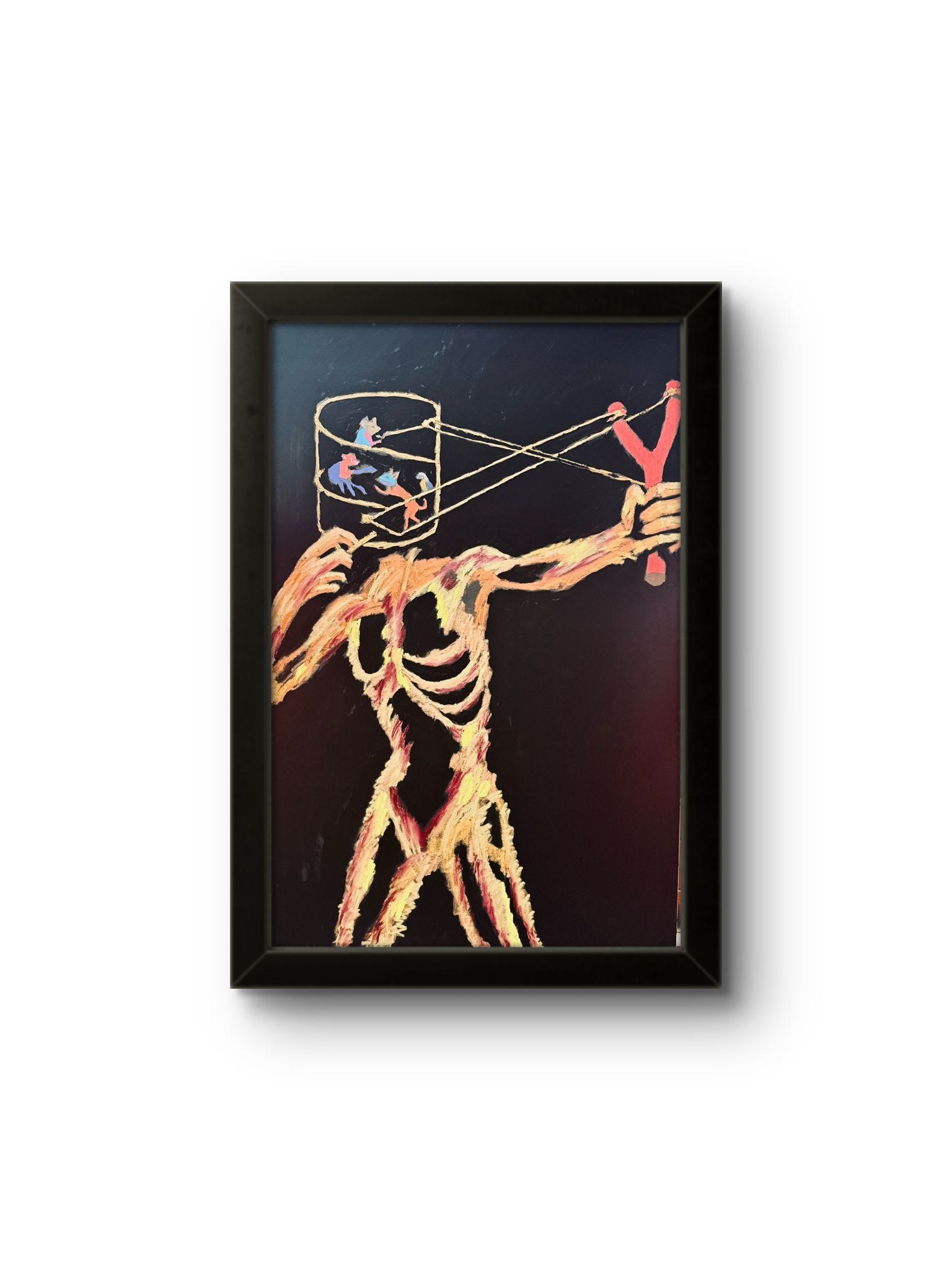
In my canvas, the theme of senseless violence is ironically embodied by the slingshot—the toy of childhood, now transformed into a deadly weapon, directed by everything that goes wrong inside our minds. The slingshot, once a symbol of innocence, becomes the outward projection of the inner conflict that turns us into zombies from within, long before the world can see it.
5.And the daffodils look lovely today. (The Dolores Portrait)
I kept wondering what kind of portrait I could create of Dolores O’Riordan, the voice of The Cranberries—at times silky, at times as piercing as the cry of a hungry baby.
How could I imagine her in a way that would honor her memory without slipping into sentimentality? My art about her had to be memorable as well.
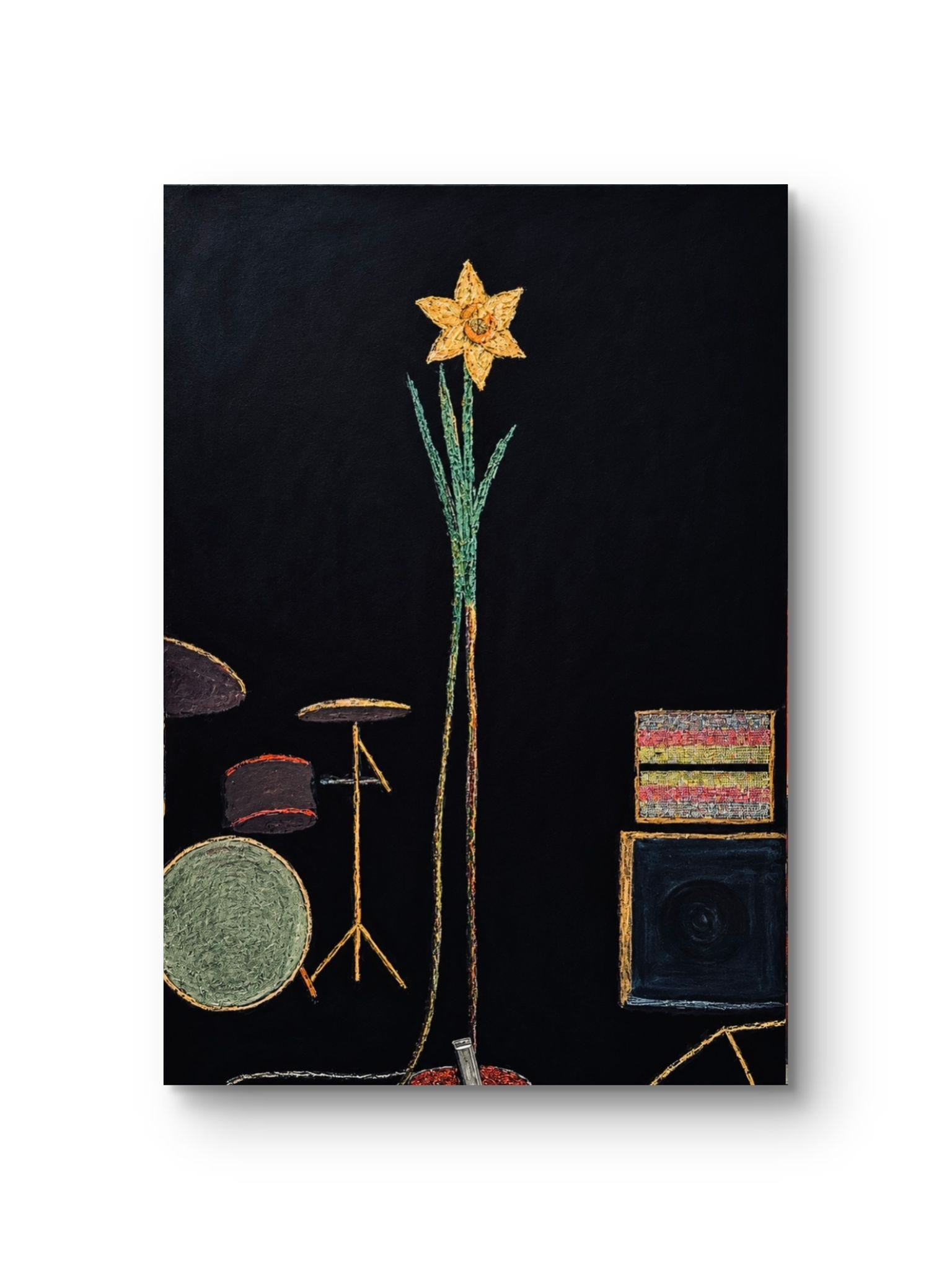
“And the daffodils look lovely today” (The Dolores Portrait) este pânza-ancoră a seriei, un portret esențializat proj care mi-am zis sǎ refuz trăsăturile fizice ale unui tribut, mi-am dorit sǎ redau spiritul ei pur.
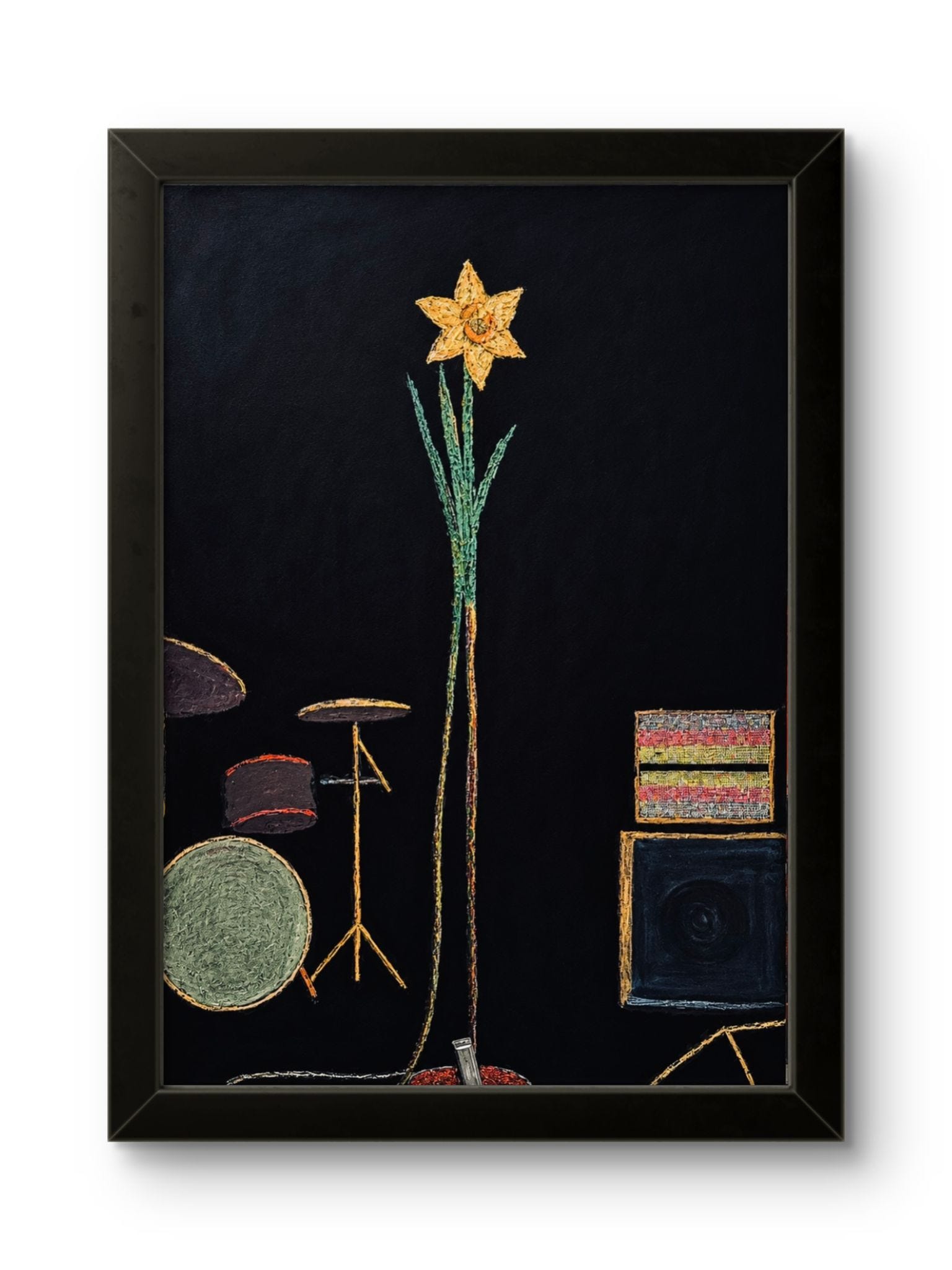
Ineditul conceptual al lucrării rezidă în transformarea stativului unui microfon — unealta muncii sale de o viață — într-o narcisă vibrantă.
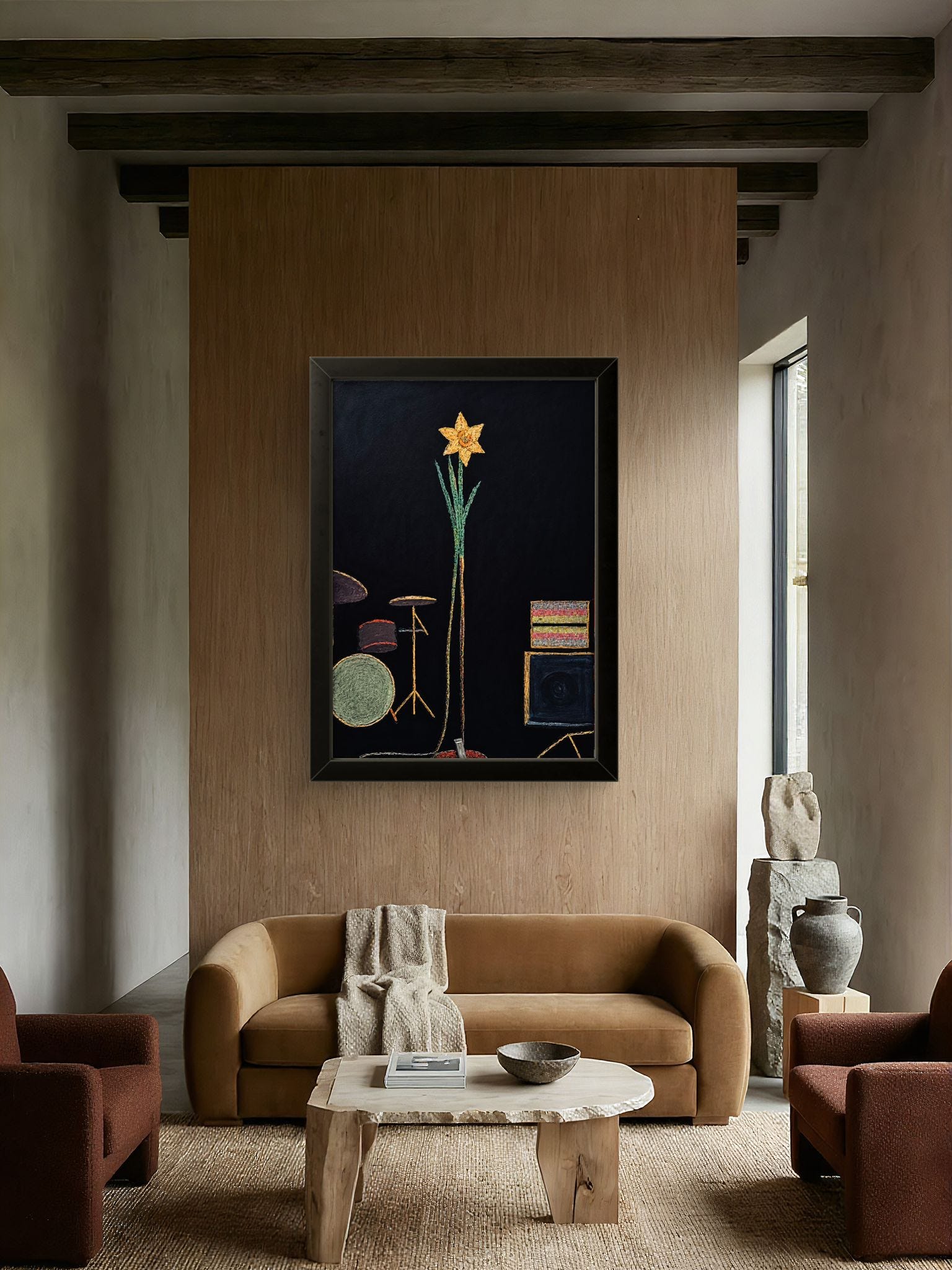
Dolores was a daffodil.
The microphone stand no longer supports the voice—it becomes Dolores herself, blooming alone on a funerary stage of silence.
The daffodil is spring’s ill-fated flower, the fragile rival of the tulip—a bloom of hypnotic beauty, yet destined to fade quickly.
It does not survive time; it burns brightly and briefly.
That is the ultimate metaphor for Dolores O’Riordan: she composed and sang by burning herself from within.
It is the painful truth behind the legend—Dolores was a voice far too great for such a small body.
Like the daffodil that bends beneath its own weight, she carried the burden of a vocal genius that slowly consumed her mind, leaving behind, on the world’s darkened stage, only the memory of yellow petals that refuse to wither in the minds of those who truly understood her.
6.No need to argue
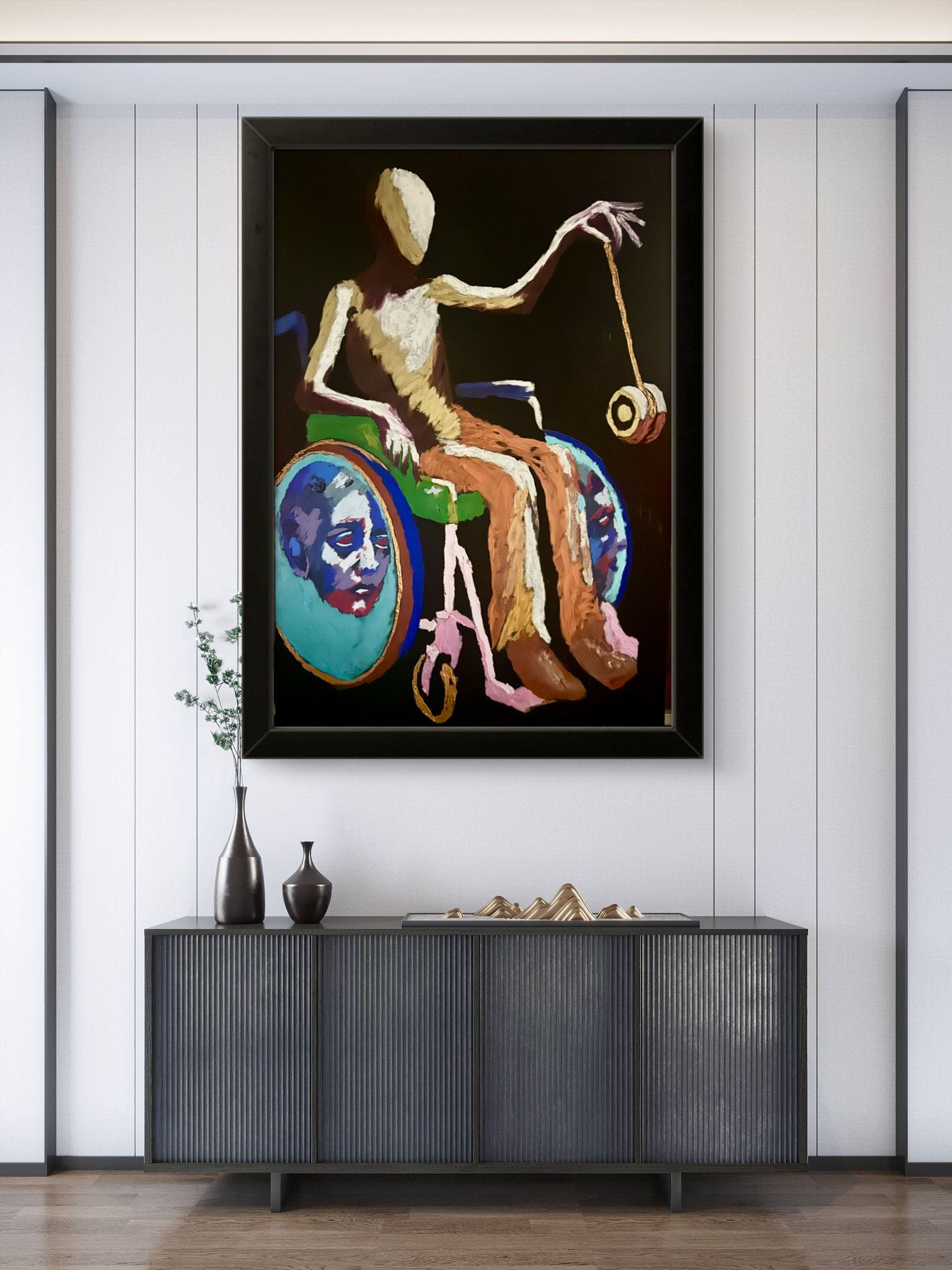
The sixth canvas, No Need to Argue, is an image of resignation in the face of emotional paralysis, when a love that is lost beyond recovery becomes a permanent bruise, and memories—or the endless “what ifs”—become the wheels of a wheelchair that leaves you mentally immobilized.
My connection to this song is even more personal. I was fifteen when The Cranberries released their most haunting album, and because I was in love with someone I could never truly have, at the age of first love, I experienced Dolores’ lyrics differently. I understood her idea of the pain carried by a heart that still longs to love, even after it has made mistakes.
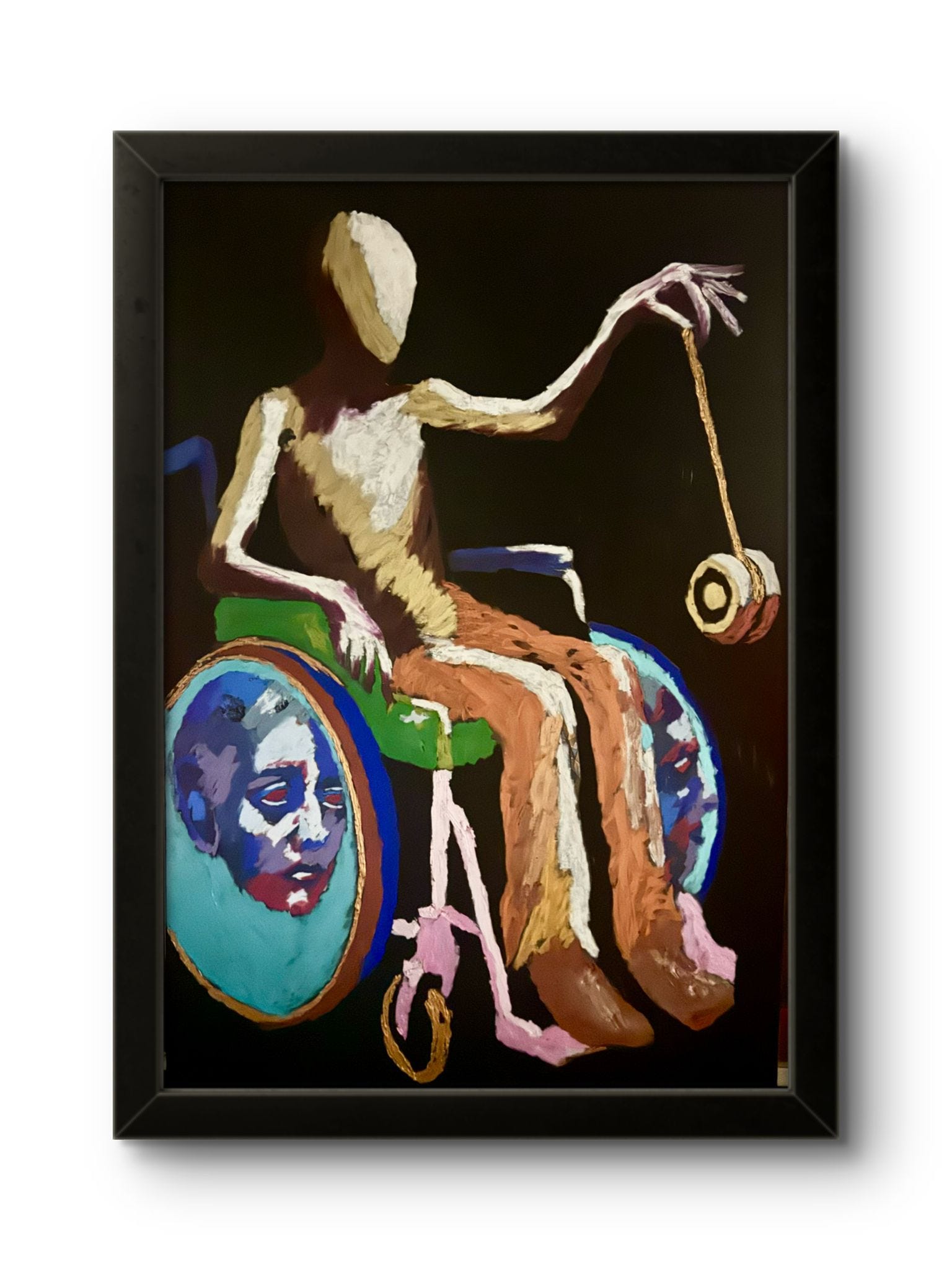
The central figure, seated in a wheelchair whose wheels are haunted by her own face, also speaks to Dolores’ growing inability to keep fighting after she was diagnosed with bipolar disorder.
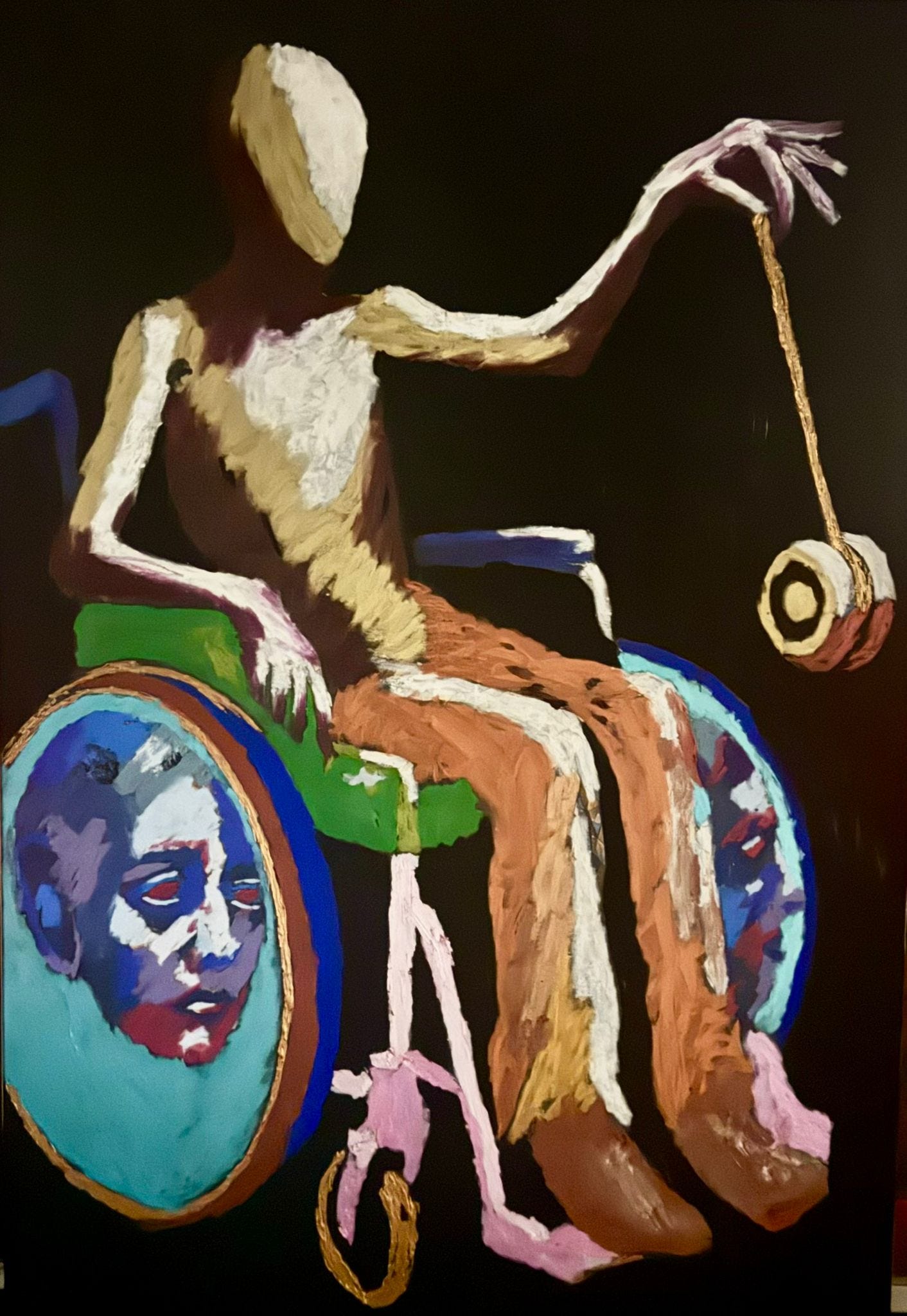
In the hand of the bewildered figure, a yo-yo traces the agonizing path of bipolar disorder: up and down, hope and collapse, all beneath the vacant gaze of a face that has surrendered its identity to pain. It is the moment when Dolores, exhausted by the “war inside her head,” accepts that sometimes we are carried through life by the fragments of our own broken selves, becoming trapped in the wheelchair of loneliness—for who wants to love a mad person?
7.“Will You Remember?” (The Funeral Feast of the Abandoned Bride)
The seventh canvas is the funeral pyre upon which the last fragment of Dolores’ love burns away. She is not merely an abandoned bride—she is a bride physically disintegrating before our eyes, just as in the song, which begins cheerfully with the waltz of a barrel organ announcing the champagne of celebration, only to end on the very same melody, transformed into the requiem of love.
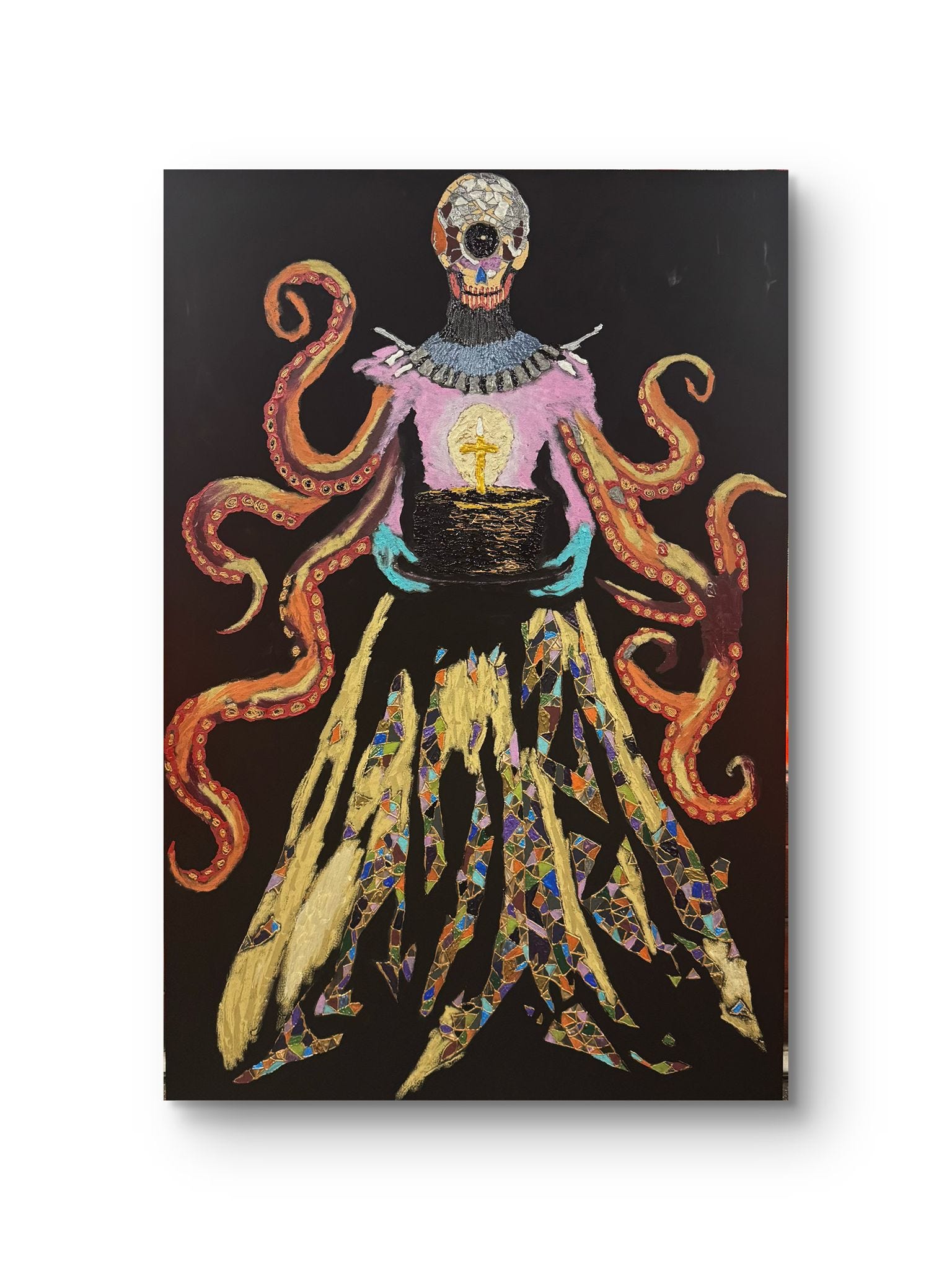
The stained-glass wedding dress falling apart is not the central element of this disaster. If in Empty the stained glass was the prison of childhood, here it has become the very substance from which the woman—Dolores herself—is made. But the glass no longer holds together; it shatters, flowing from her like solid tears, leaving behind a void that no wedding dress can conceal.
The planned future lies at her feet, collapsed into thousands of razor-sharp shards.
In place of the face she begs her lover to remember stands a blind Cyclopean eye—a vast, unblinking lens of disappointment.
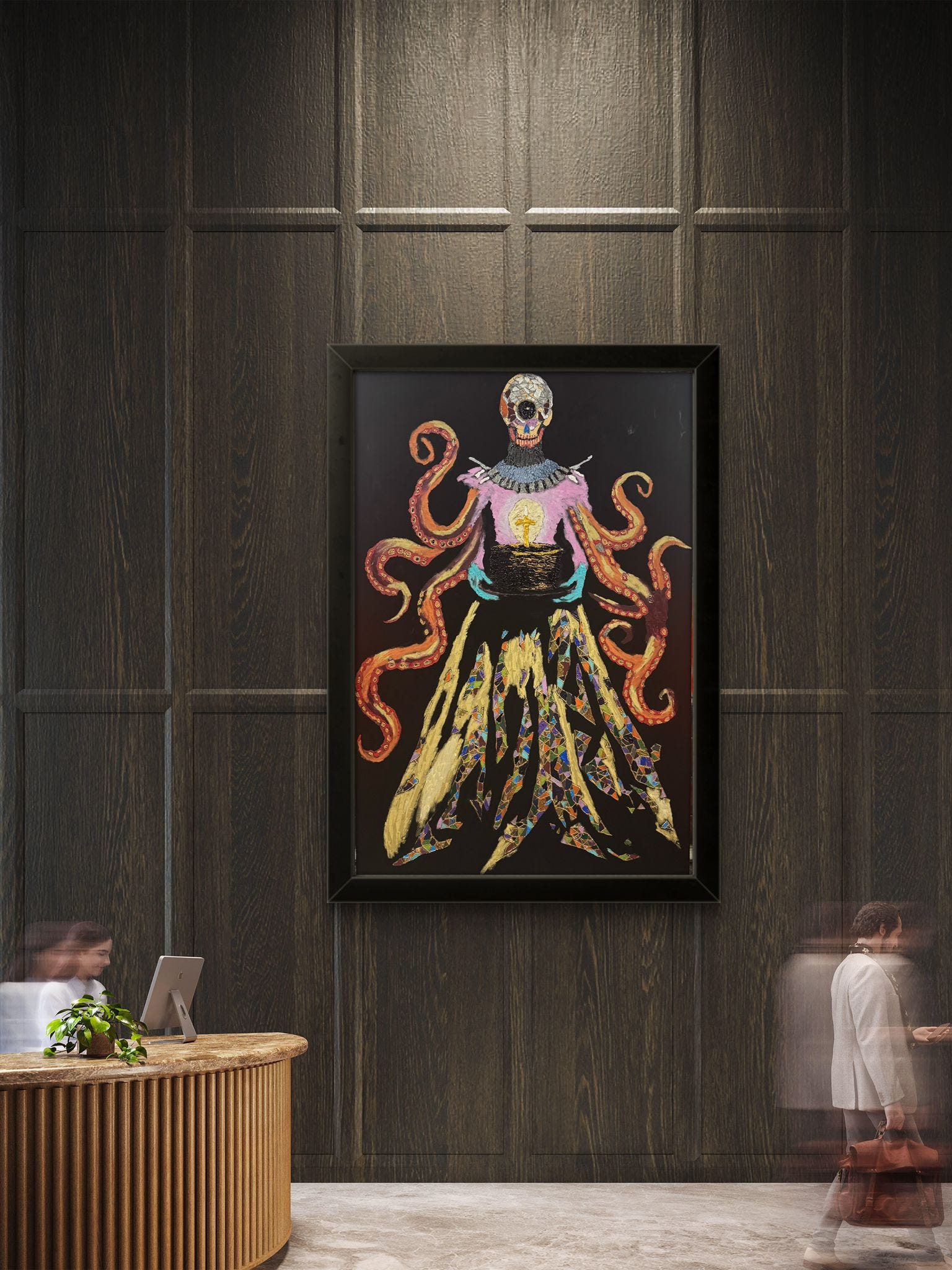
It is the eye that never blinks—the curse of mutilated love.
From behind this ghostly bride erupt octopus arms, the black tentacles of a parasitic memory. They do not embrace her; they claim her. They are the arms of fame tightening around her, suffocating her—the very “limousines” that came not to take her to her wedding, but to carry her toward oblivion.
Like every abandoned bride who refuses to accept her fate, my black bride clutches a funeral cake in mute desperation, crowned by a single candle shaped like a cross, illuminating the funeral feast of absence.
Now, it is no longer the limousine that should arrive, but the hearse, to carry the bride forever into the depths.
8.Ridiculous Thoughts
Ridiculous Thoughts is the eighth canvas in the series dedicated to the personification of mental illness and to Dolores O’Riordan, the lead singer of The Cranberries, who passed away at the age of 46.
It captures one of the most difficult moments in an artist’s life, when the pressure of the public and the media demands that you offer yourself completely to the world—both body and soul—accepting to be sliced open and dissected, mocked and questioned from every possible angle.
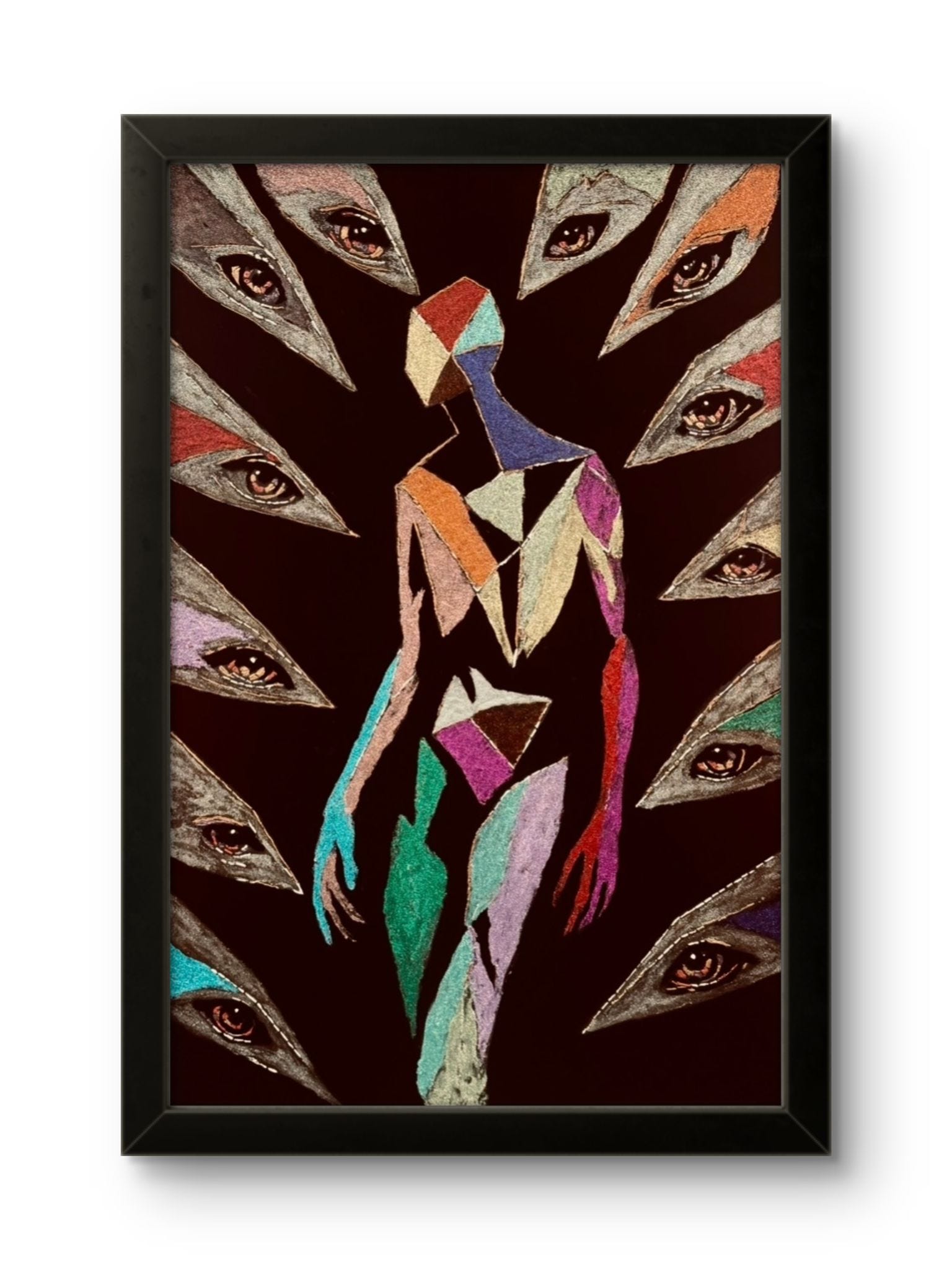
The song bearing this title was, at the time, Dolores’ protest against the British press intruding into her private life. But the lyrics reveal that something far deeper was unfolding beneath the surface: a twister—a tornado of cold thoughts beginning to form, laying the groundwork for paranoia.
The world wanted all of her. The tragedy is that Dolores gave herself to that cynical world completely—with her body, her mind, and, in the end, even her life.
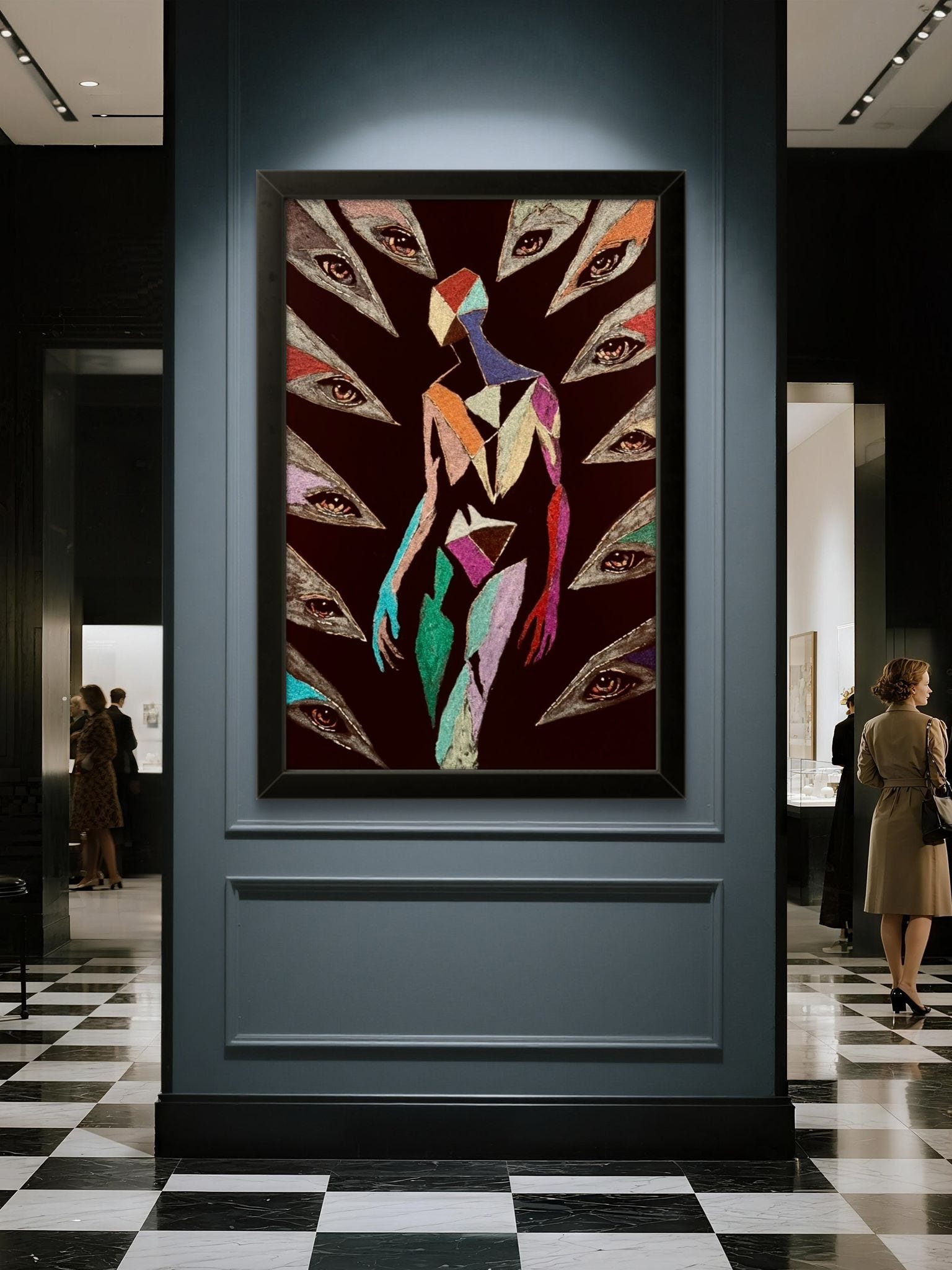
Paranoia is an exhausting illness, unlike any other. It keeps the mind permanently wired with absurd thoughts that terrify you every second until you begin to disintegrate—inner mirrors feeding on you until you no longer wish to remain human.
There is no escape, because the only door to salvation lies behind your own eyelids, and by then, all that remains is darkness.
9. I Will Always
I Will Always is the ninth painting in the series dedicated to the emotional earthquakes within ourselves and within Dolores O’Riordan, the lead singer of The Cranberries, whose unique, paradoxical voice I honor through this artistic tribute.
This song is extraordinary because, although it lasts less than three minutes, it draws you into a haunting trance—a lullaby of death about the self that once existed and the self it eventually became.
This painting is also a self-portrait of mine suspended between two moments in time. But it could just as easily be your portrait. It is certainly Dolores’ as well.
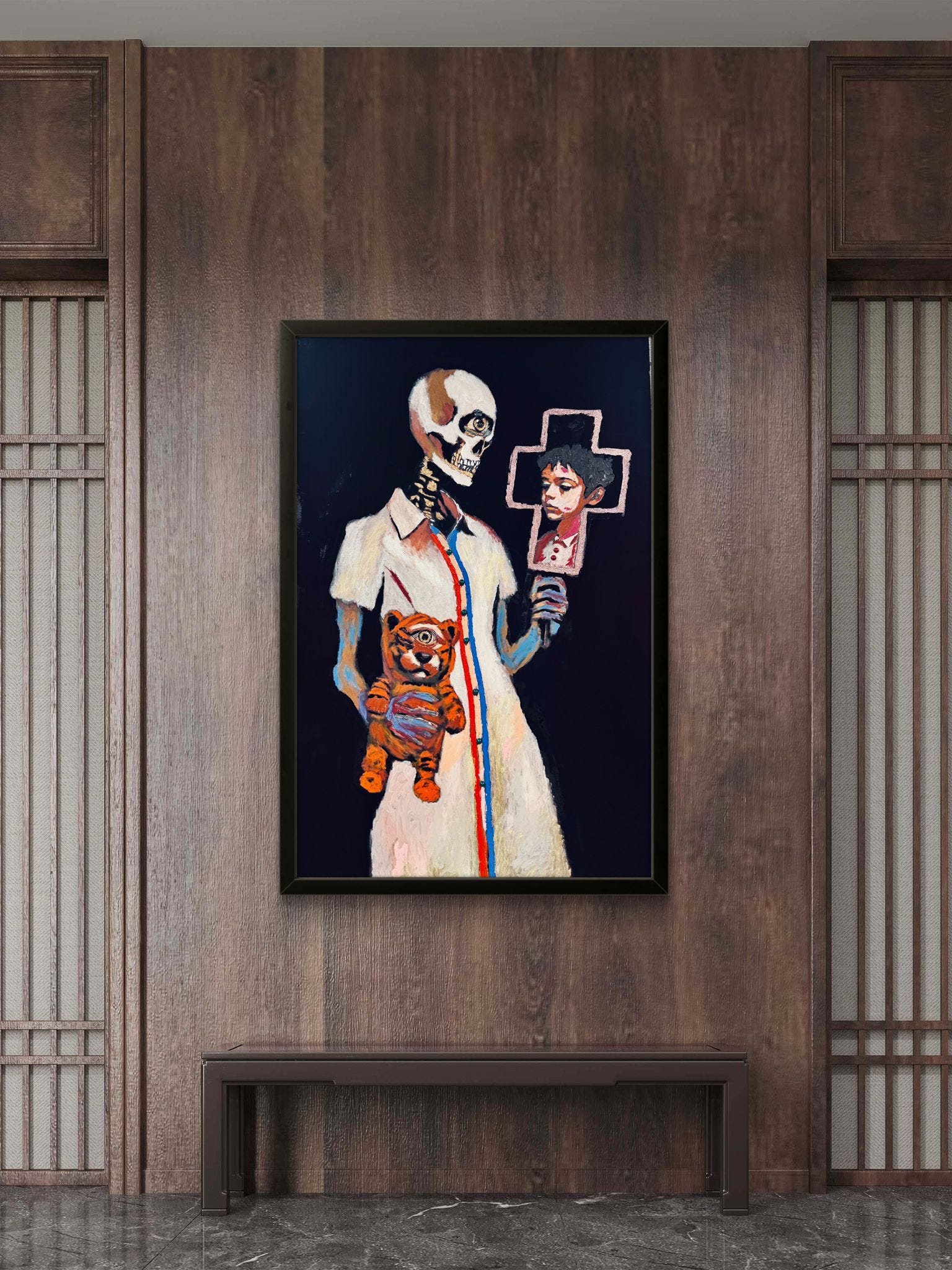
Especially the older Dolores, whom I have dressed in the uniform of childhood—a white shirt with two stripes, like the pages of a first-grade notebook, still stained by the marks of life.
Here, Dolores is a Cyclopean skull, the burned self that never truly left this world, that still longs to play with the one-eyed stuffed tiger—a creature that sees everything and forgets nothing.
A strange mirror, framed by a glittering pink cross, reflects the image of Dolores as a child. It is the former self, the self that existed before everything happened, the one with whom the burned Dolores speaks: “I Will Always Be with You.” We do not know which self spoke those words first, or which one kept the promise.
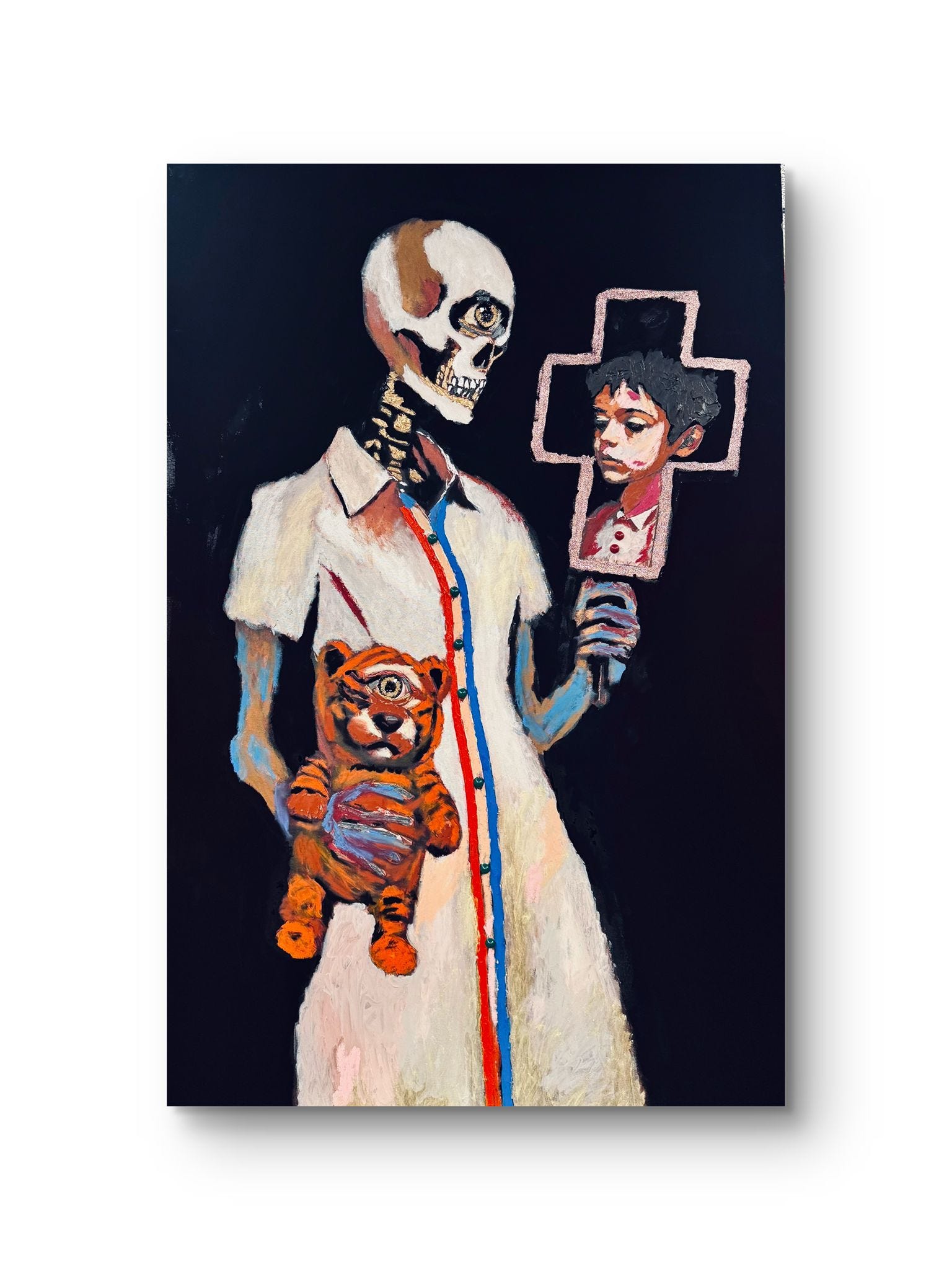
My painting is not about death. It is about the fact that we are never just one person across a lifetime—that we are an uncanny conversation between who we are now and who we were yesterday. Our memories hold one another’s hands the way former lovers do across the table in a cheap bar, looking at each other in silence, when there is nothing left to say, yet neither one wants to be the first to leave.
10.When you’re gone
This beautiful song was originally written by the late Cranberries singer Dolores O’Riordan as a way of coping with the death of her grandfather. Later, however, she revealed that its lyrics and emotional meaning had taken on new dimensions over the years—expressing the longing she felt for her father, as well as the homesickness for her family during the band’s long tours.
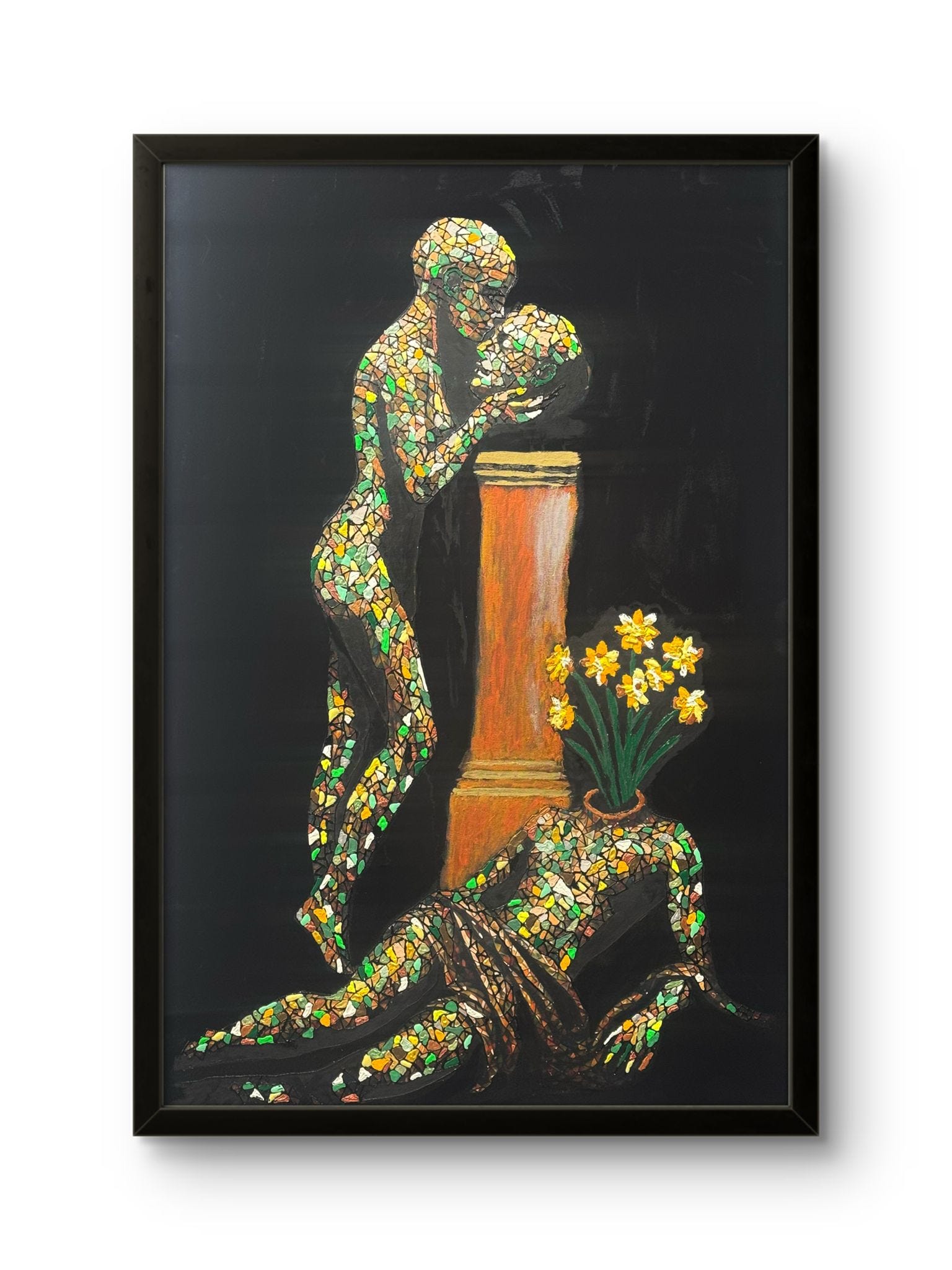
We keep telling ourselves to live in the moment, but we hardly know how to cherish it.
Instead of legalizing marijuana, perhaps we should legalize nostalgia.
I love missing people, times, and moments, even when the memories hurt.
In my painting, the tenth in The Daffodil Lament series, I have imagined for you what longing for someone who has left this world looks like.
I don’t need to offer any further explanation for this painting.
If you have ever felt that longing—for your mother, for a lost love, or for happiness that will never return—then words no longer matter.
11.Sunday
I have fought my own difficult battles with the darkness of the soul that we now more commonly call major depression. Back then, I felt as though I was collapsing upward.
We mistakenly believe that collapse is always downward. True collapse happens when you become detached from yourself and can no longer tell which way the world is meant to be—which direction is the sky, and which is the earth.
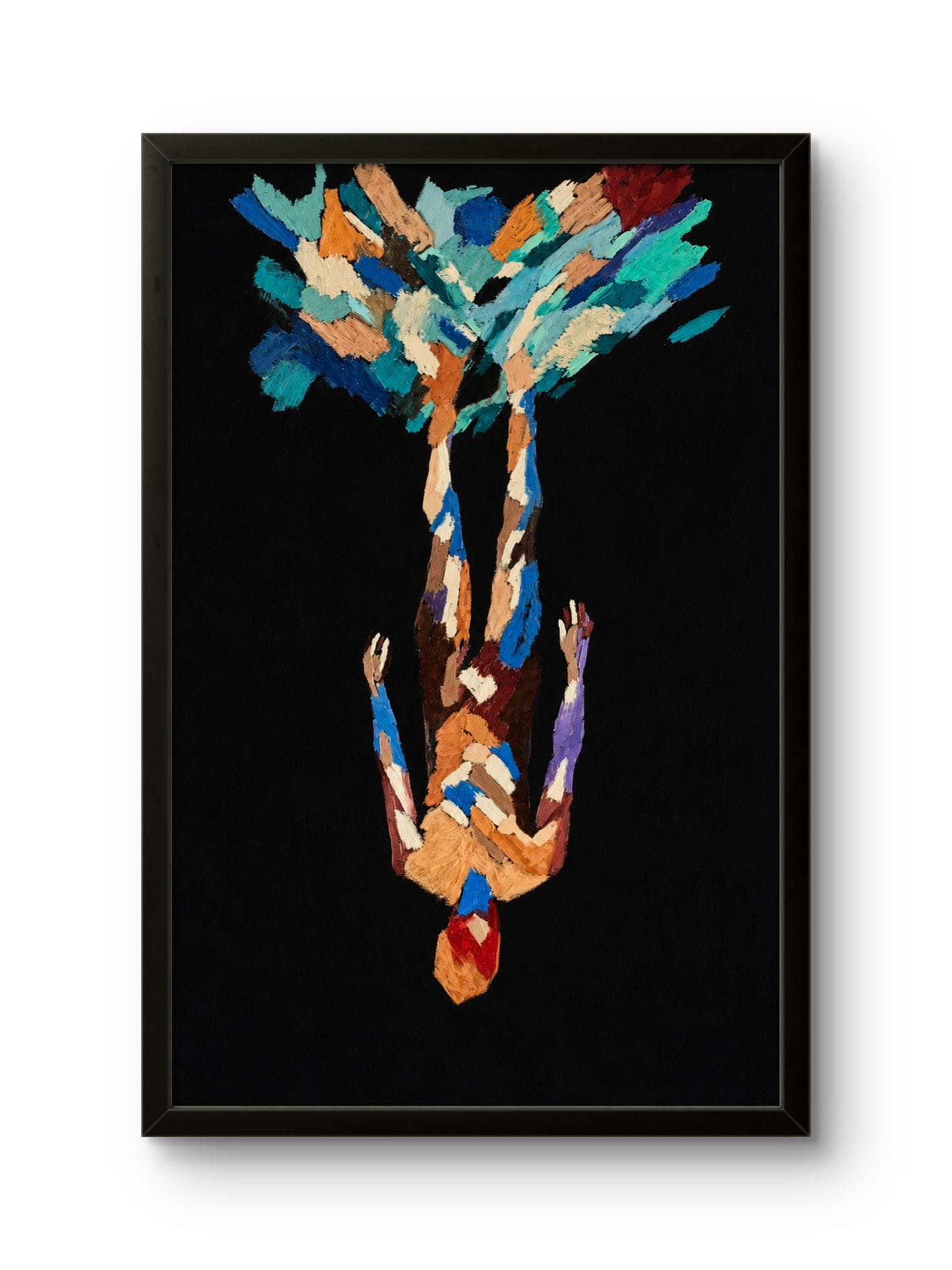
And then you drift upside down through an empty cathedral, on a Sunday when God forgot to come to the service.
This painting is the eleventh canvas in The Daffodil Lament, and it is not about suicide.
When life became unbearable—and I am not exaggerating—I would spend my afternoons hiding inside a church, searching for peace or simply looking upward. I kept searching until I found myself again.
Dolores never found the strength to do the same.
12.Just My Imagination
Dolores O’Riordan, the late lead singer of The Cranberries, said she wrote this song while thinking about the happy days—the time when she could stay in bed until Sunday afternoon, daydreaming, with no children pulling her out from under the covers, no fame, and no emotional pain. We are much the same. Only later, when life burdens us with responsibilities, depression, and unfulfilled dreams, do we truly understand what we once had.
Paradoxically, those freer days eventually return, but by then we are old, and we no longer know what to do with them.
This song is a circle—the circle of our lives.
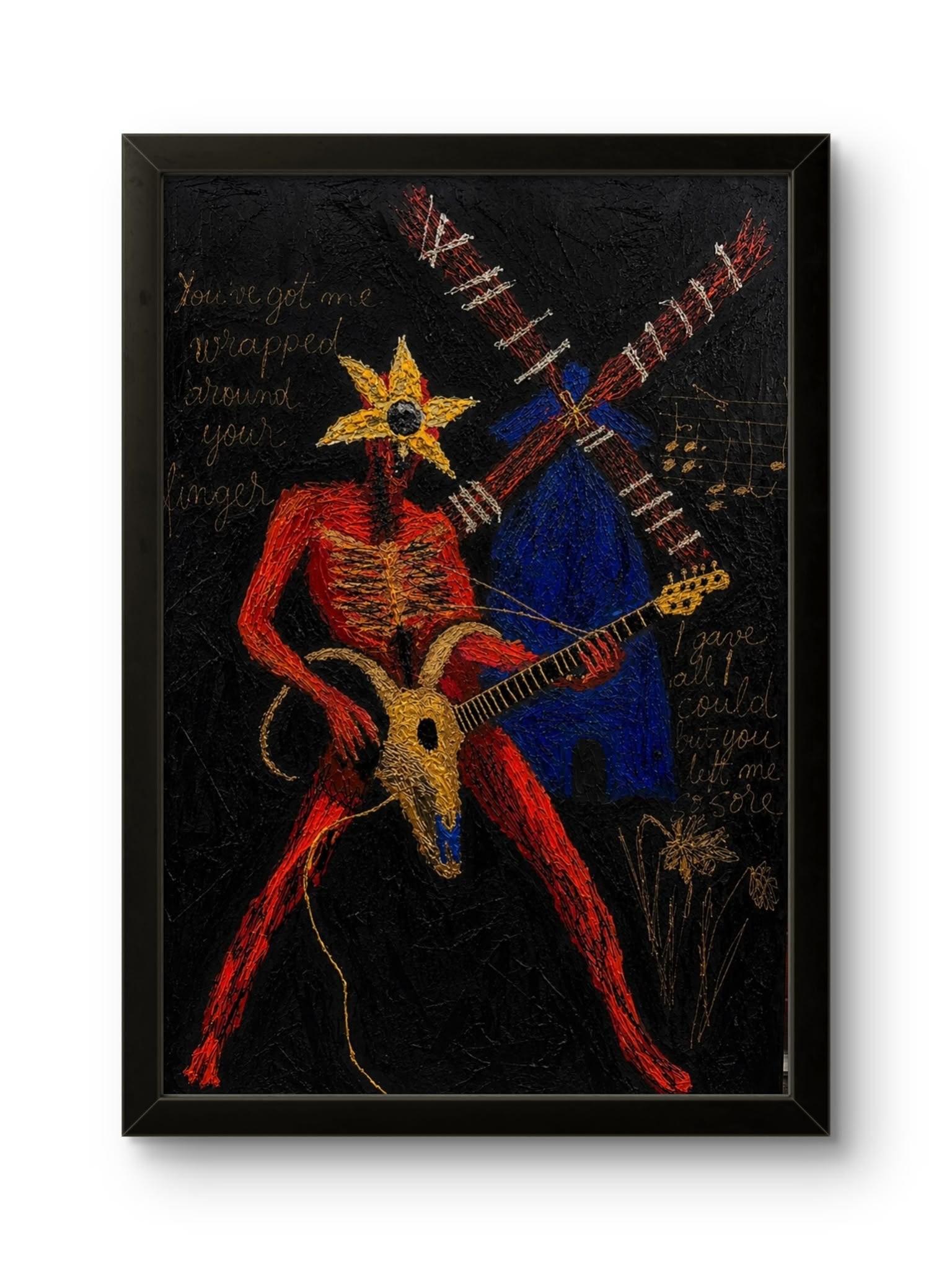
That is what I painted: a creature trapped within its own endless rotation. The red devil, stripped down to its ribs and sinews, plays a guitar fashioned from a goat’s skull—an instrument of pleasure and a tool of death, as in every life where joy and the price we pay for it appear on the same bill.
Behind it, the sails of an old Irish windmill turn without end, grinding us down, just as life does.
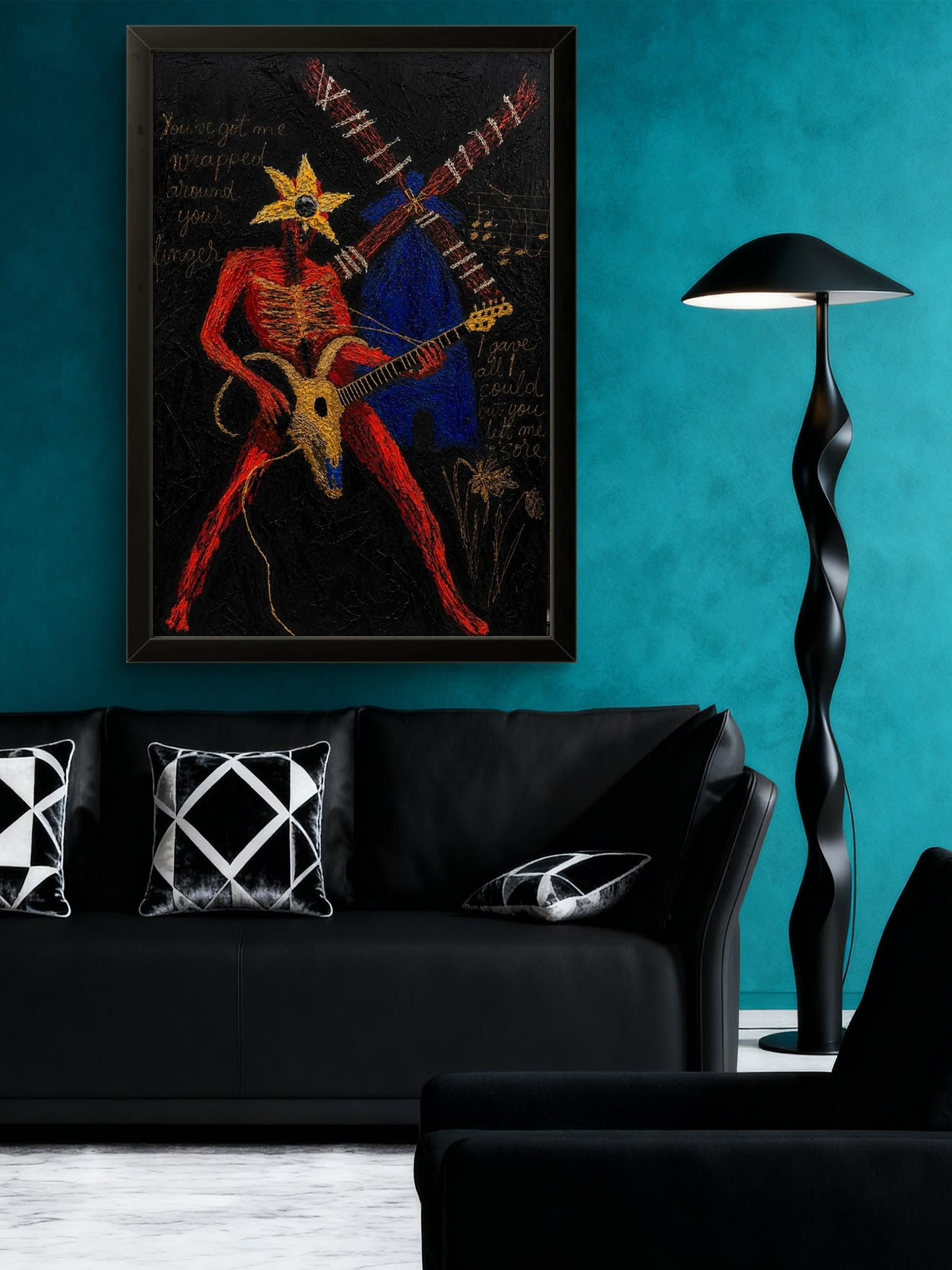
The reddened devil has no horns, only yellow daffodil petals—the signature of the entire series, the signature of Dolores, and at the same time the mask of someone who bloomed too early and left just as she was about to discover the strength of the sun.
The lyrics I painted onto the canvas—“you’ve got me wrapped around your finger,” “I gave all I could but you left me sore”—are not from this song, but from others, because pain does not stay neatly separated. That is how memory works: it piles wounds from different years onto the neck of the soul and deceives us into believing we are a single story, one coherent narrative.
But we are nothing more than a collection of beautiful lies.
13.Salvation
Salvation is one of The Cranberries’ most deceptive songs. On the surface, it seems to be about addiction and salvation, with Dolores urging young people to stay away from heroin. But to me, this song has always meant something else, something much deeper: it is more about the desperate struggle to keep from losing yourself.
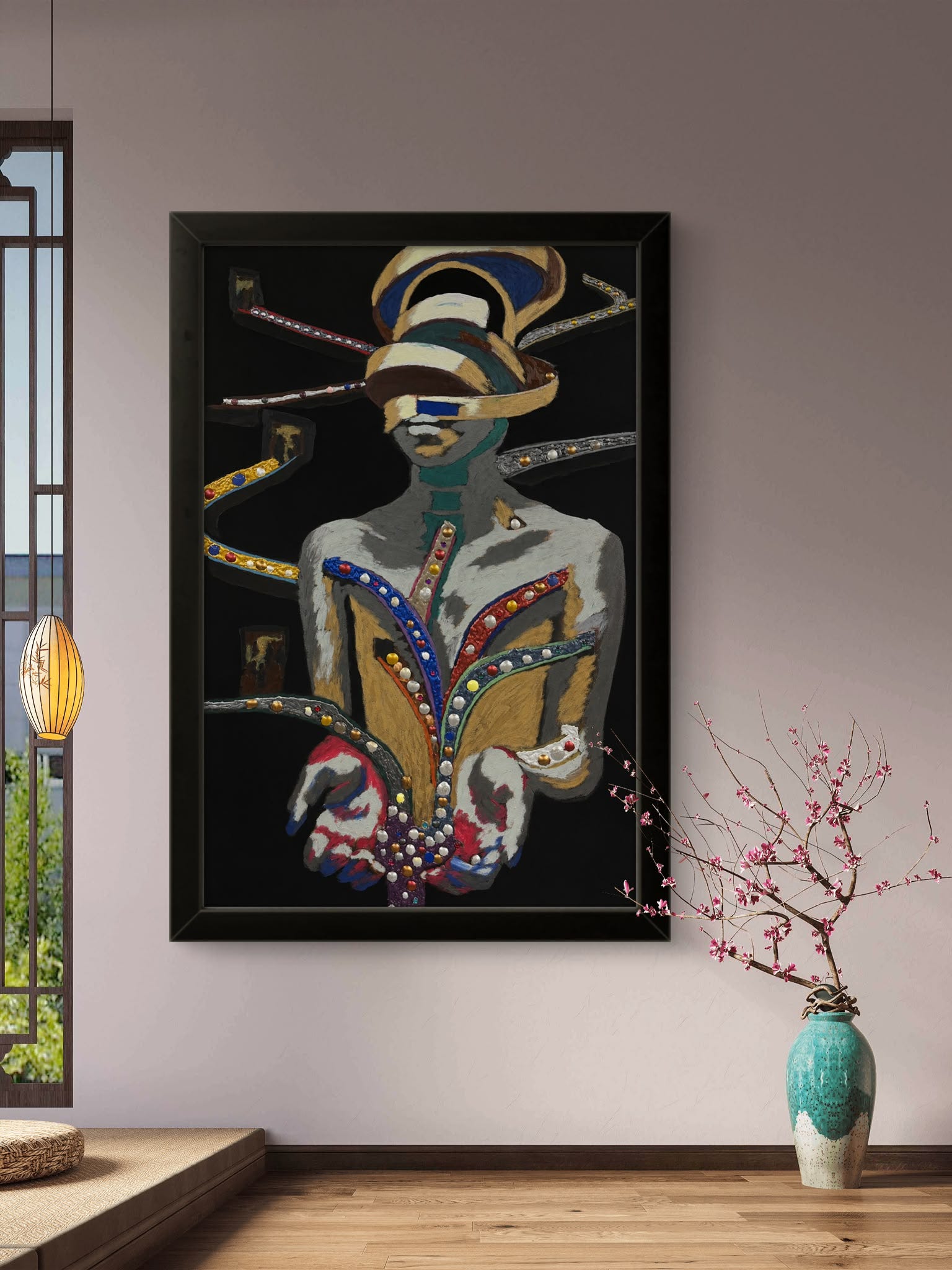
My thirteenth canvas in The Daffodil Lament series is not about drugs. It is about the fragility of the human being when life offers too many truths, too many promises, and too many paths toward a false salvation. The central figure in my painting is blinded not by darkness, but by an excess of directions.
The ribbons wrapped around the figure’s head are thoughts, doctrines, obsessions, rules, beliefs, and temptations.
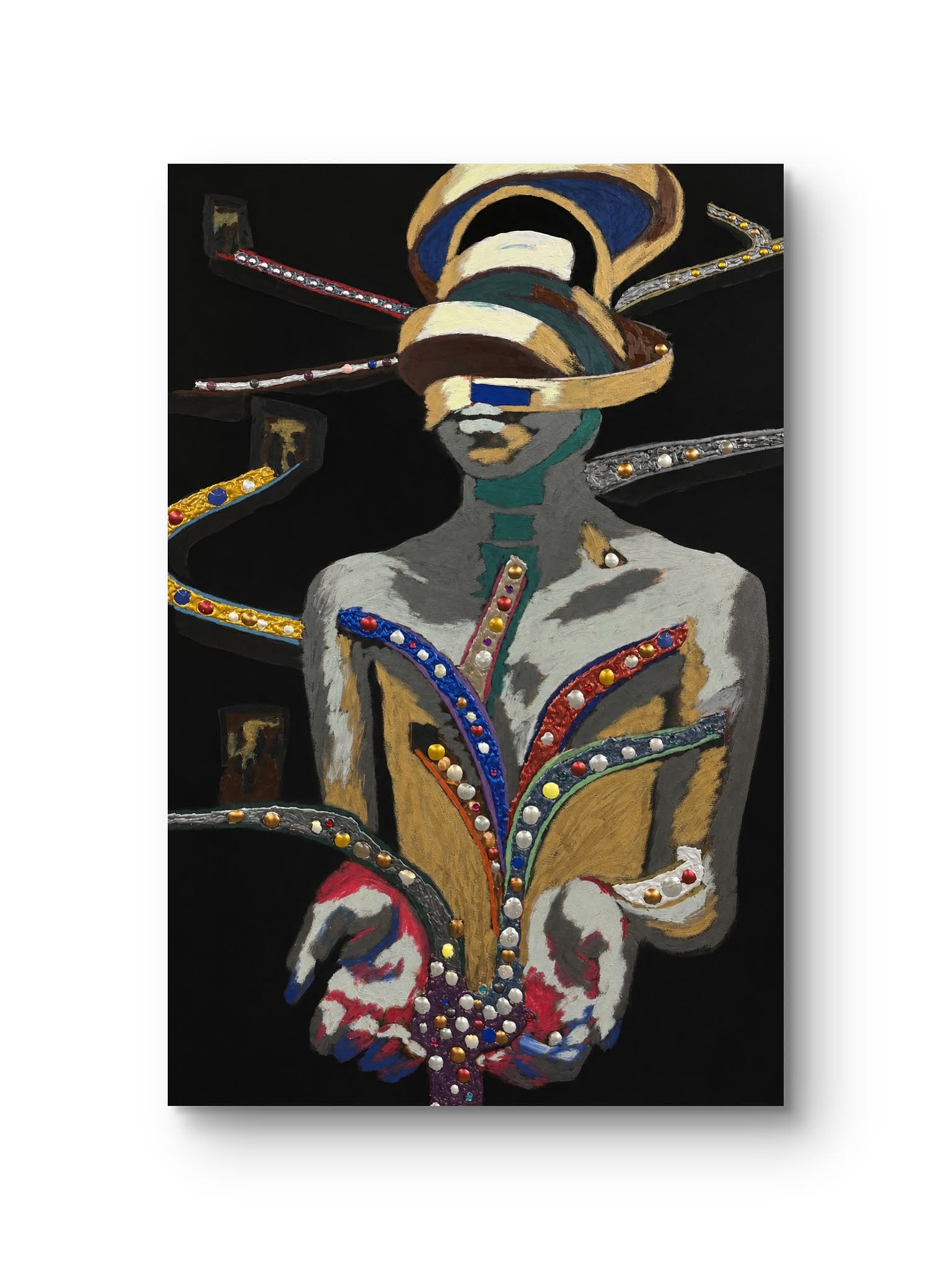
Each one seems precious, each one shines like a crown, yet together they prevent the figure from seeing clearly.
The streams of pills and pearls are all our quests: love, faith, power, success, art, glory, or simply the need to be accepted. They all promise the same thing—false salvation.
The connection to Dolores O’Riordan runs deep. Her entire life was a struggle between light and shadow, between faith and pain, between the need to be loved and the need to hide. There was always a sense in her voice that somewhere beyond the noise of the world and the demons within, some form of redemption existed.
Sadly, her salvation came in a hotel room bathtub. Beneath the water, she locked away her final breath so that, at last set free, she could breathe in the stardust.
14.Icicle Melts
Icicle Melts is the fourteenth canvas in the series dedicated to Dolores O’Riordan, the lead singer of The Cranberries. In this song, Dolores expresses her anger over the death of a child killed in Liverpool. But to me, the song reveals another aspect of her psychological world: an extraordinary sensitivity to the suffering of society, and the way certain souls are simply incapable of keeping the world at a distance. They absorb everything—every injustice, every act of cruelty, every disappointment—until each one becomes an intimate wound, as though it had been inflicted upon their own body.
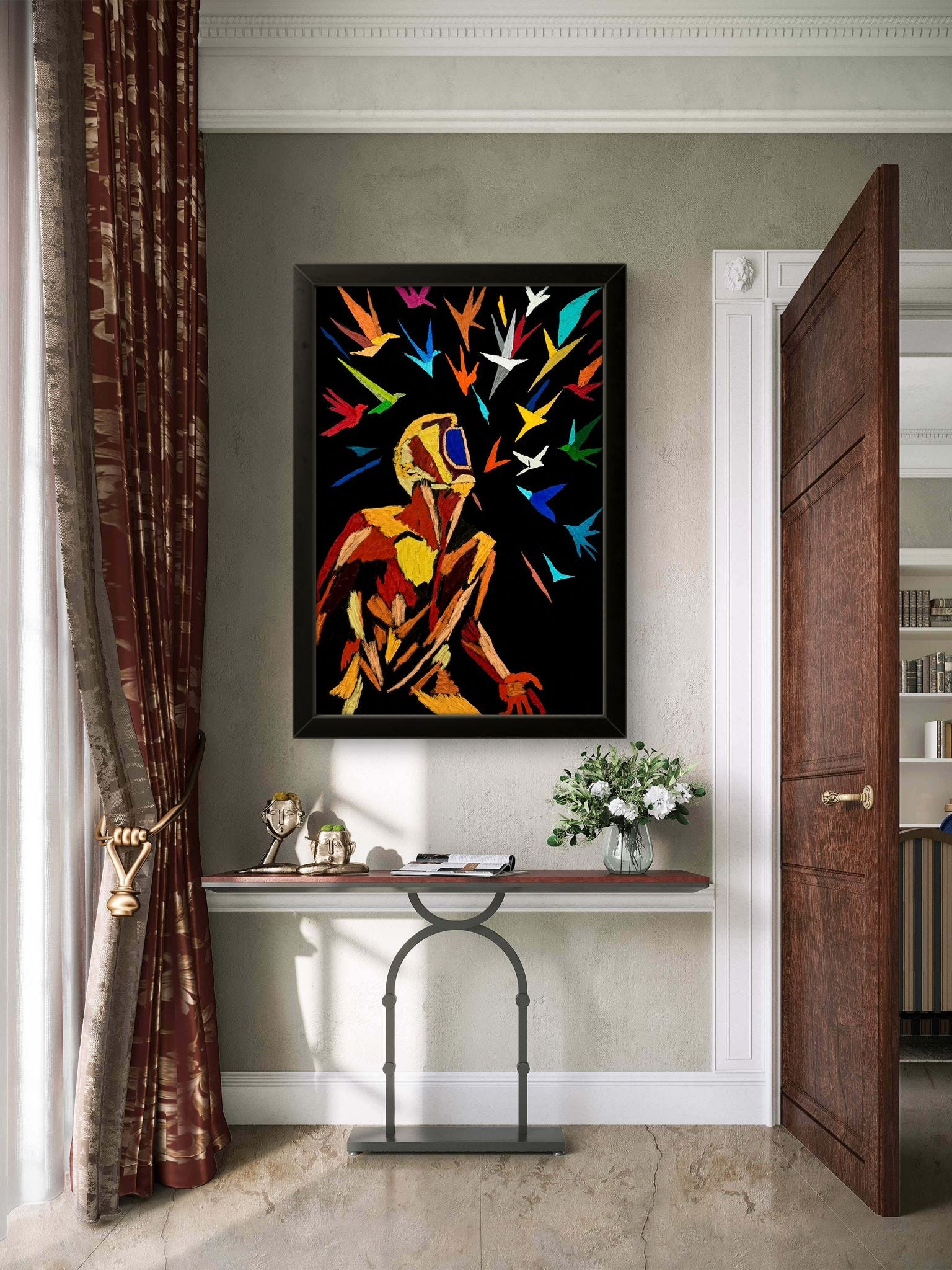
The figure in the painting screams in frustration, and those screams transform into colorful origami birds—fragments of thoughts, ideals, hopes, and fears that no longer fit inside a human mind. They are every lost cause, every tragedy in the world, every moral battle that some people carry until they destroy themselves. There is no longer any boundary between the self and society. The pain of others becomes your own.
At first, it feels like a form of nobility. Then it becomes a prison. You feel compelled to save everything, to fix everything, to answer for everything that is broken around you. And when the world refuses to change, you begin to melt along with it, like an icicle.
This is where my connection to Dolores lies. Behind the voice that filled stadiums was a human being who felt everything. Far too deeply.
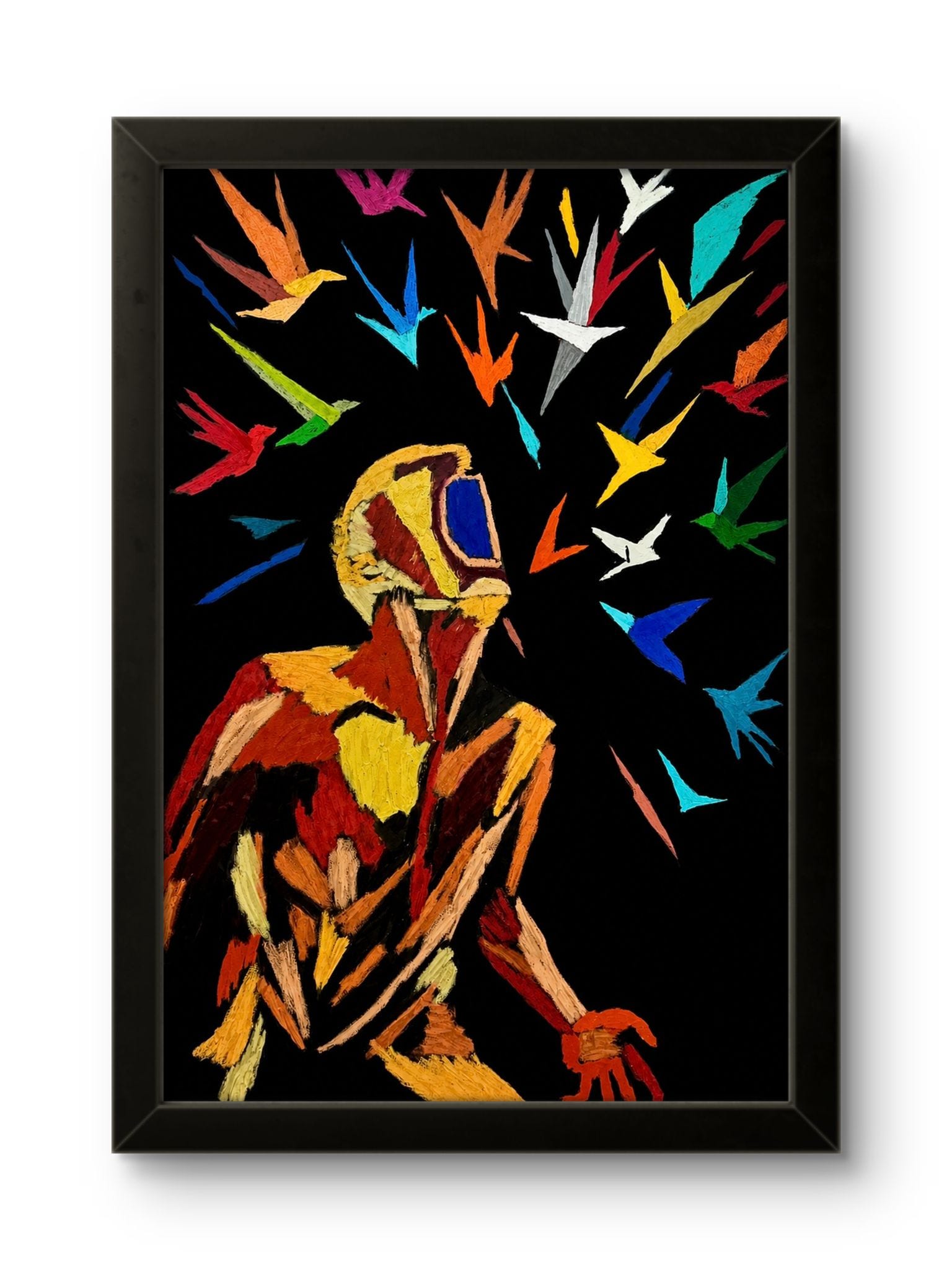
My painting is not about madness. It is about the price an artist pays for being deeply sensitive.
Artists may appear strong to those around them, but inside they melt away slowly, trying to change the world.
But the world does not change. It remains the same—unpredictable and full of chaos. And in chaos, the only certainty is that the icicles are the first to disappear.
15.Pretty
Pretty, the fifteenth canvas in The Daffodil Lament series, returns to the underlying theme of the psychological struggles of a gifted artist, and Dolores O’Riordan carried more than her share of them.
Dolores was not the only one who suffered from a fragmented sense of self. Many of us do, without even realizing it.
At least I do.
I admit that I allow people to consume me.
That is the fate of dreamers—we carve ourselves into pieces with our own hands.
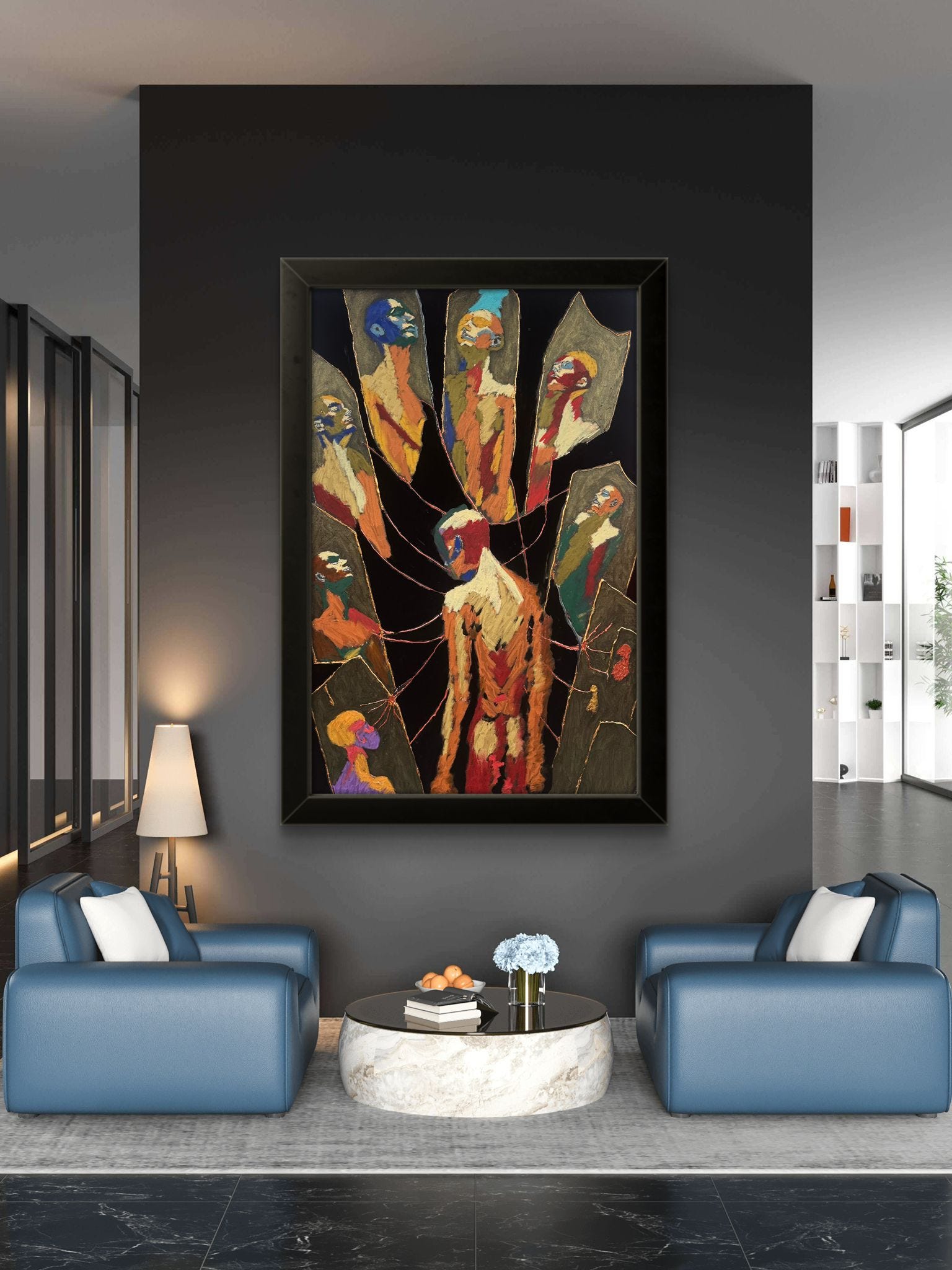
A piece for my family. A piece for those who love me. A piece for those who admire me. A piece for those who judge me. A piece for those who need me.
The faces suspended throughout my painting are not different versions of the self, but emotional debts I have accumulated in order to be accepted. The child who wanted to be liked. The adult who wanted to prove himself. The artist who wanted to be understood. The man who forgot how to sing.
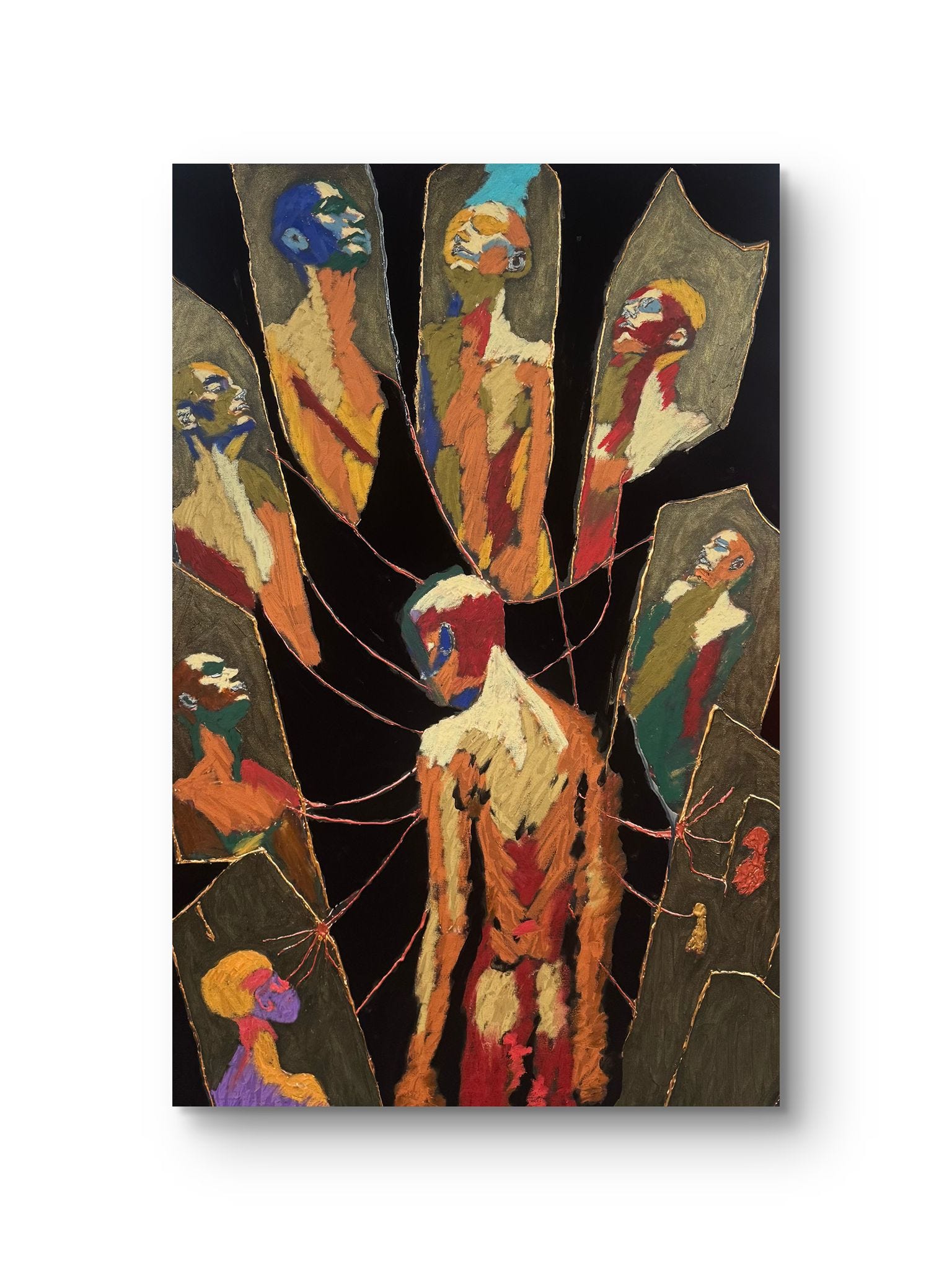
The threads that bind us to ourselves are the very threads we have woven. That is why they are so difficult to cut—because every strand we sever wounds us.
We are the ones who spun the spider’s web in which we have permanently trapped ourselves.
16.Ordinary Day
„Ordinary Day, the sixteenth canvas in The Daffodil Lament series, is the joker of the collection—the only painting set against a white background, standing in complete dissonance with the other twenty dark canvases.
It is a painting about people who are incapable of living on the surface of life.
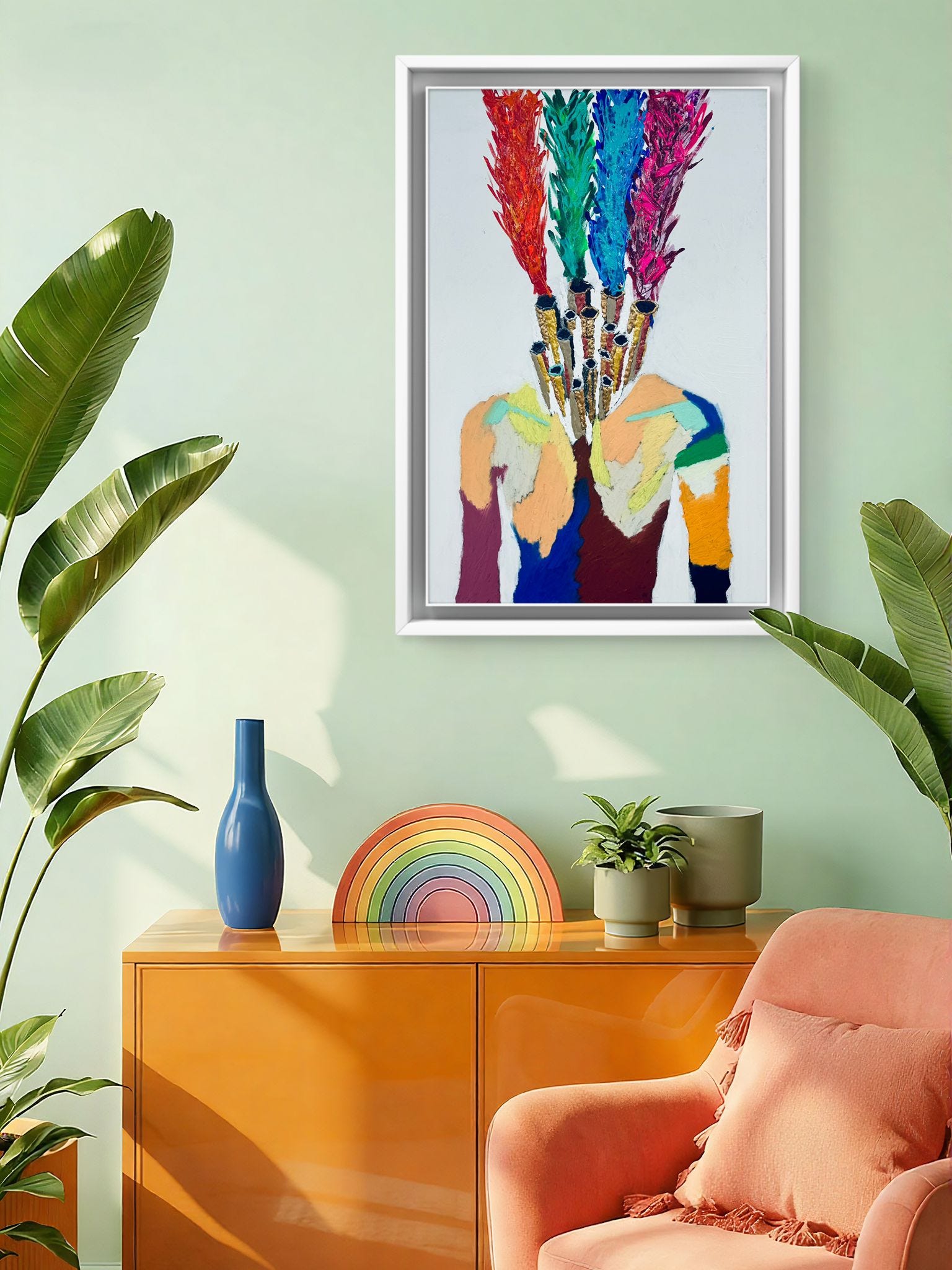
In my imagination, what emerges from the spinal bulbs of an outwardly peaceful body are not nerves, vertebrae, or tissue, but organ pipes playing colorful thoughts—the kind that only truly beautiful minds can create. Each pipe becomes a conduit for imagination, and every burst of color is an inner chord: an emotion, a memory, or an idea refusing to remain imprisoned within.
I associated this work with Dolores O’Riordan’s Ordinary Day because the song speaks of the quiet miracle of existence and the way an apparently ordinary day can become extraordinary when seen through the right eyes.
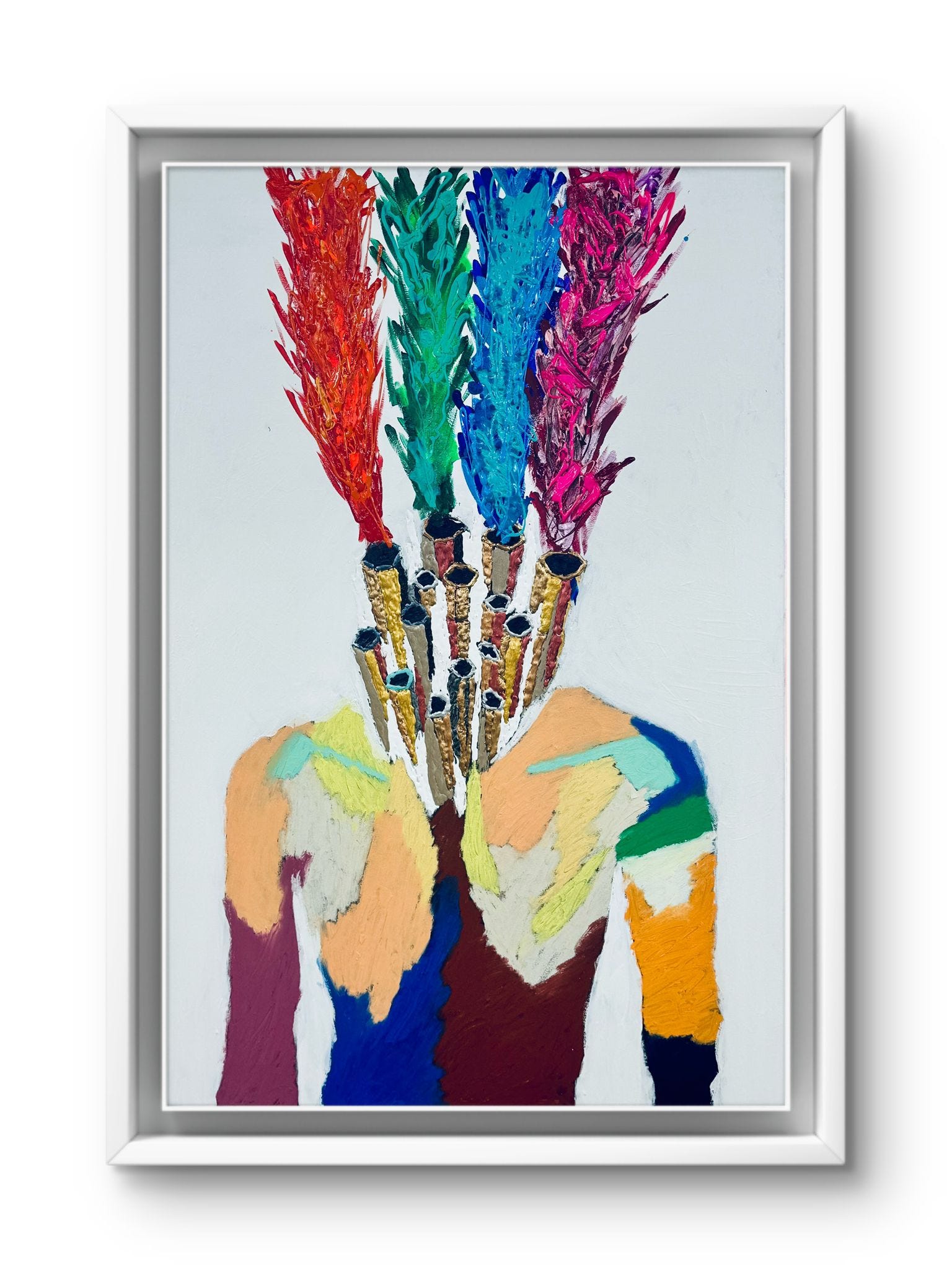
For most people, the world is made of objects. For those who are truly sensitive, the world is made of meanings.
That is why the figure has no head. The body has become irrelevant as a form; what remains is a sounding cathedral, where only those with an open heart can hear the Liturgy of Colors.
17.The Daffodil Lament
This work is dedicated, in a deeply personal way, to Dolores O’Riordan’s departure from this world, capturing the precise moment when inner anguish meets the sovereign decision to withdraw.
I want you to see it as a visual requiem—the way I imagine her final unwritten song might have looked: an ontological negotiation between Dolores and Life itself.
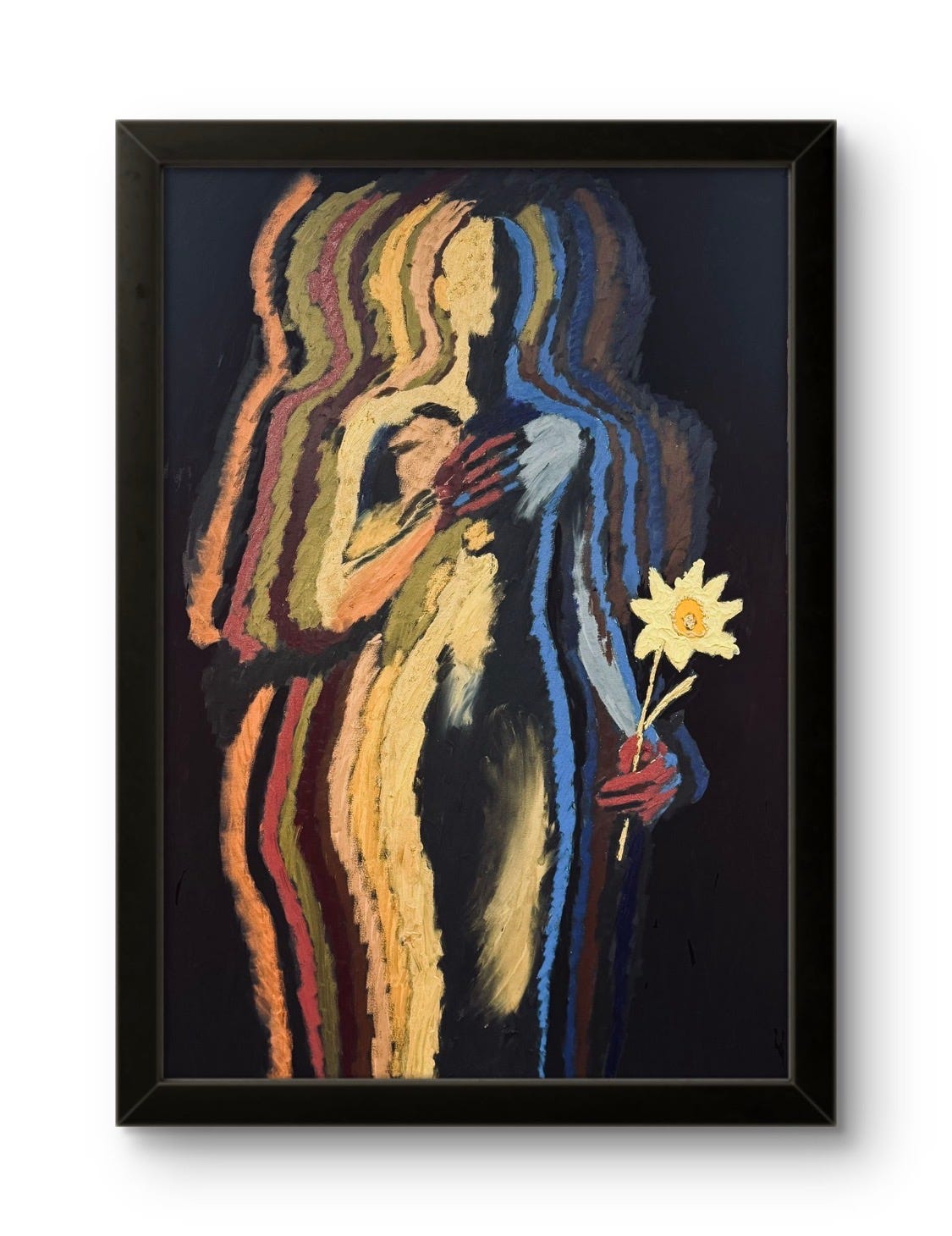
The heartbreaking question Dolores asks Life itself—“Would you notice, if I left you?”—takes on an almost unbearable weight. It is the moment when a consciousness comes to believe it has become irrelevant within the immense, and often indifferent, machinery of the universe.
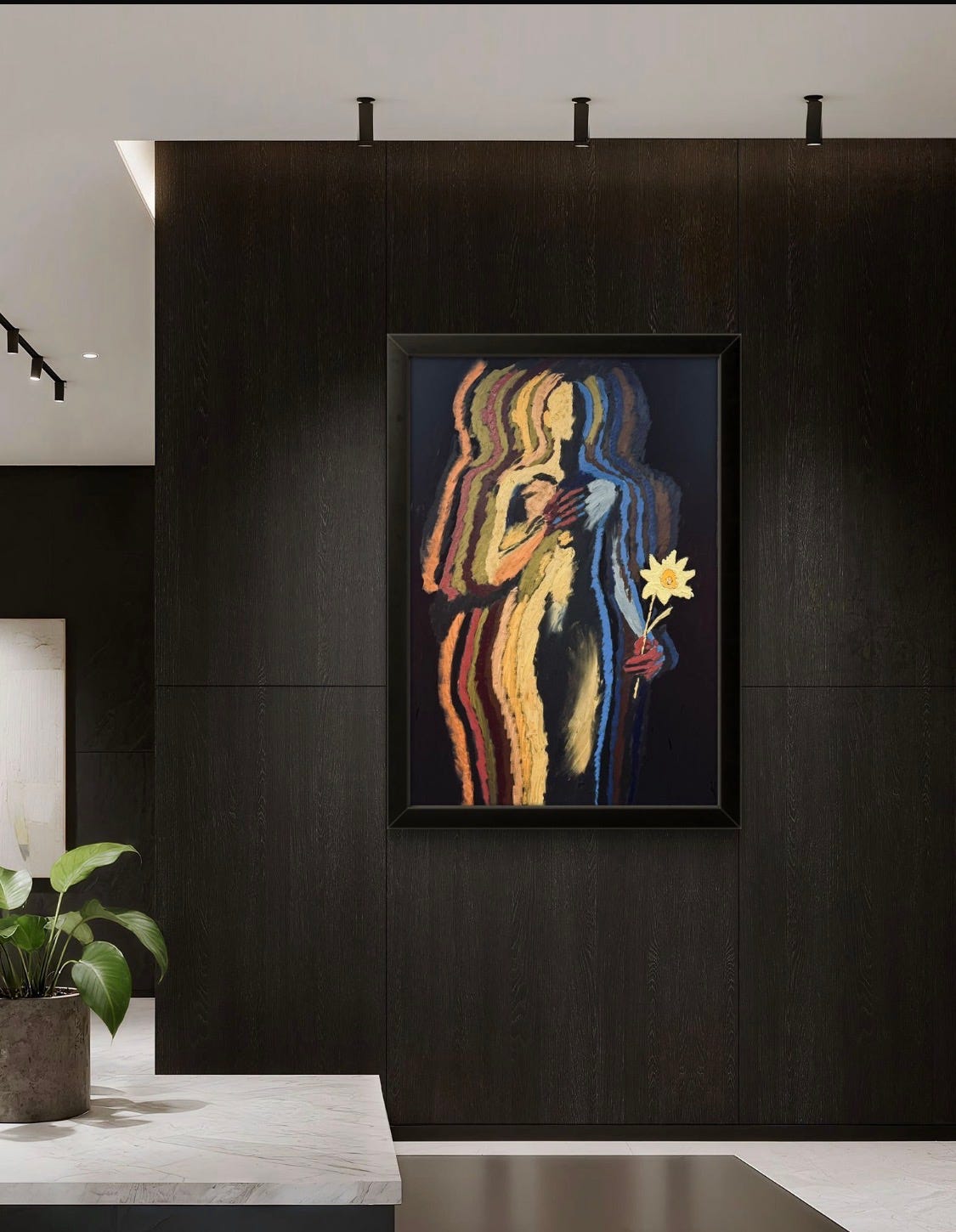
My painting mirrors this process of detachment through multiple trembling layers of color—bronze, ochre, gold, and blood—imagining Dolores in the midst of dissolution, or perhaps transfiguration: the final sealing of her suffering.
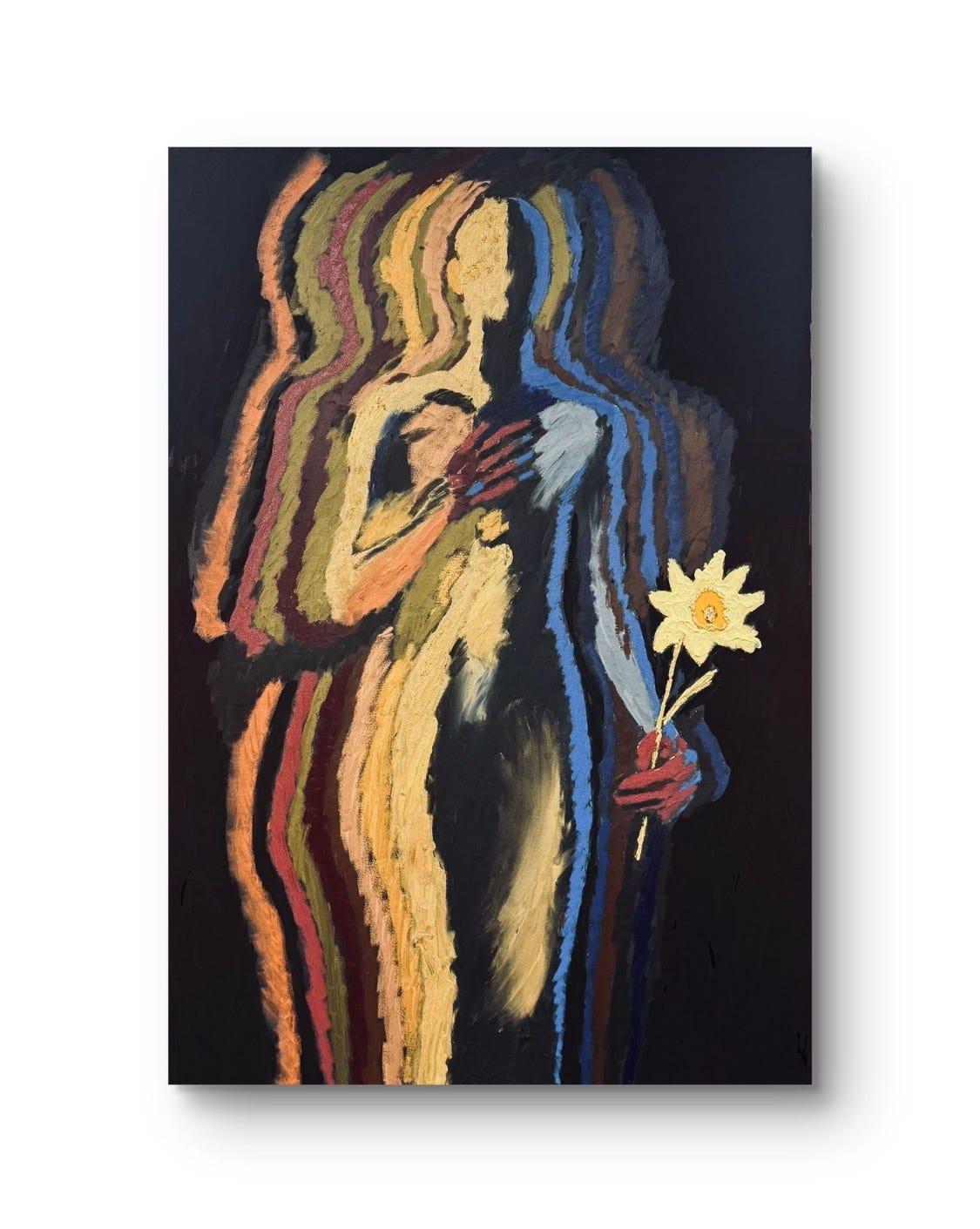
In her left hand, she holds a single yellow daffodil. It is no longer a symbol of spring, but the fare Dolores offers Charon to cross the Styx. It is the final payment under the Contract, allowing her, at last, to sing forever in freedom.
18.The Last Day of the Last Daffodil
Artists like Dolores O’Riordan of The Cranberries spent half their lives in hotel rooms. Like Jim Morrison, Dolores also spent her last day on Earth in the lonely anonymity of a hotel room.
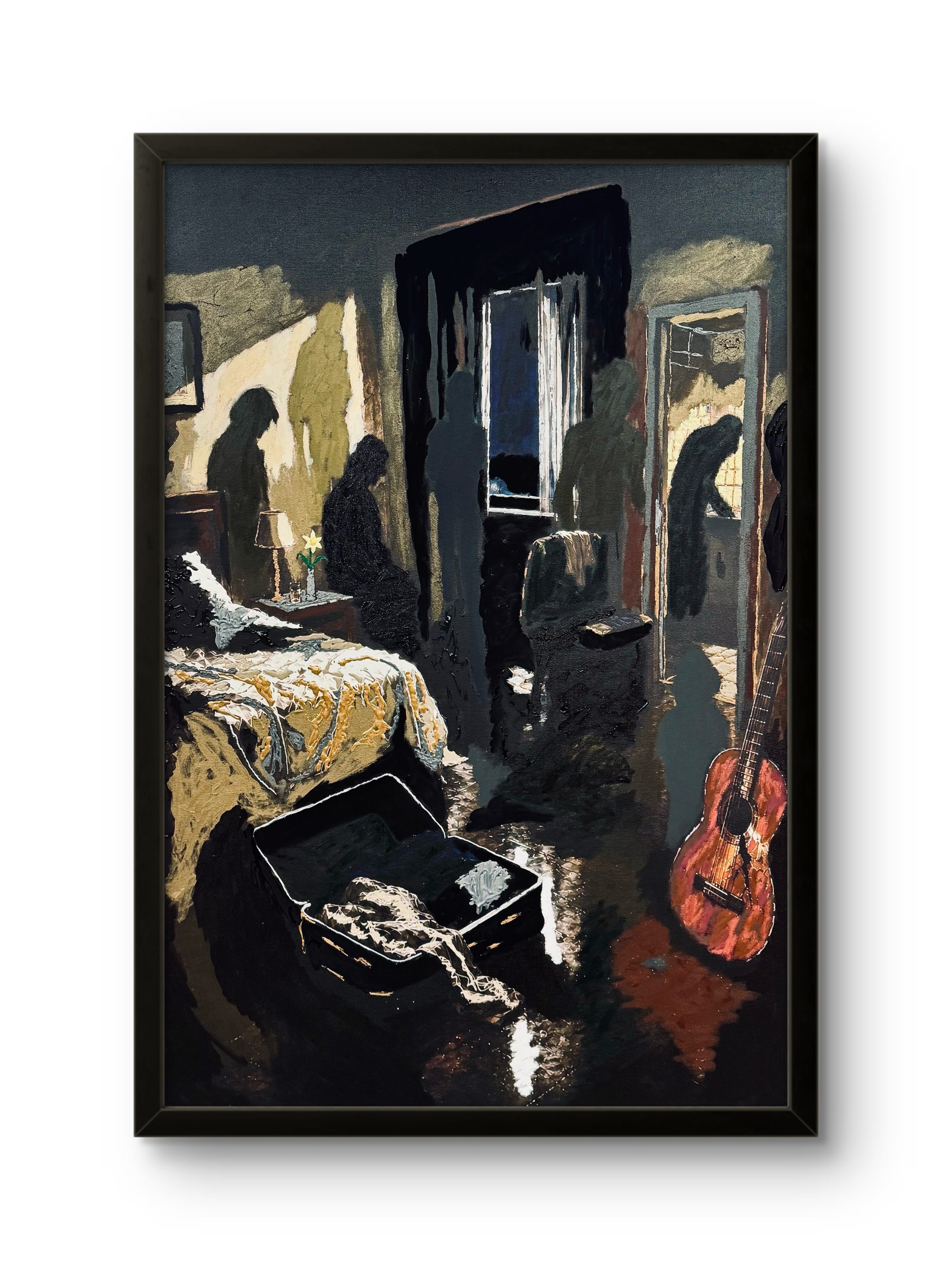
The Last Day of the Last Daffodil is my attempt to imagine not Dolores O’Riordan’s death, but the terrifying silence that came just before it.
The eighteenth canvas in the series does not speak to you—it transmits that unsettling state of restless unease. Dolores is composed of several shadows: one walks toward the bathroom, another breathes in short, uneven bursts at the window into the blackness of the night, while another stares in bewilderment at a guitar that is expected to play an impossible song.
The bed flows like a funeral river. The war with the soul is over.
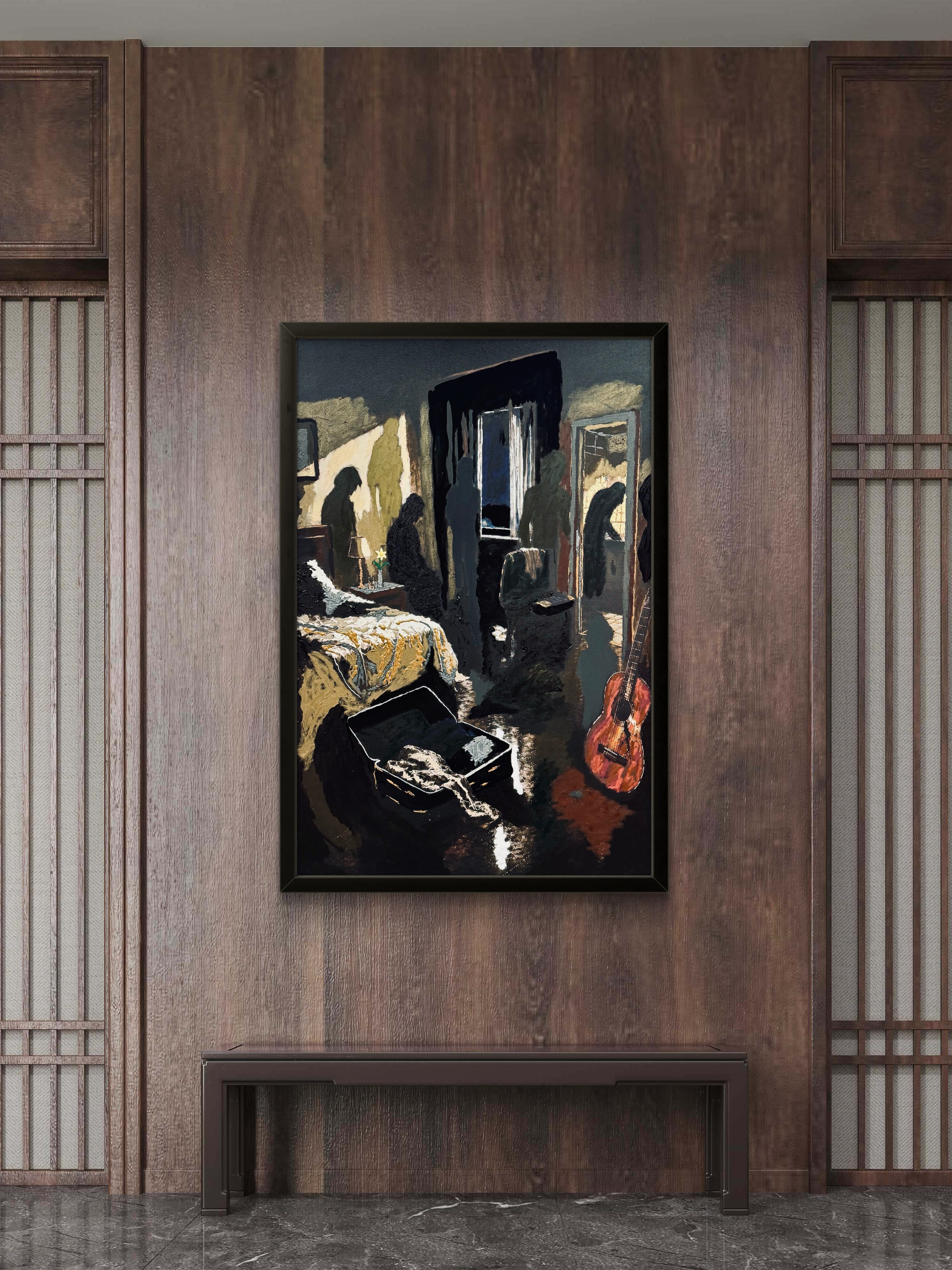
Here, pain, memories, and refrains cease to be merely a state of mind and become a place that only you can enter.
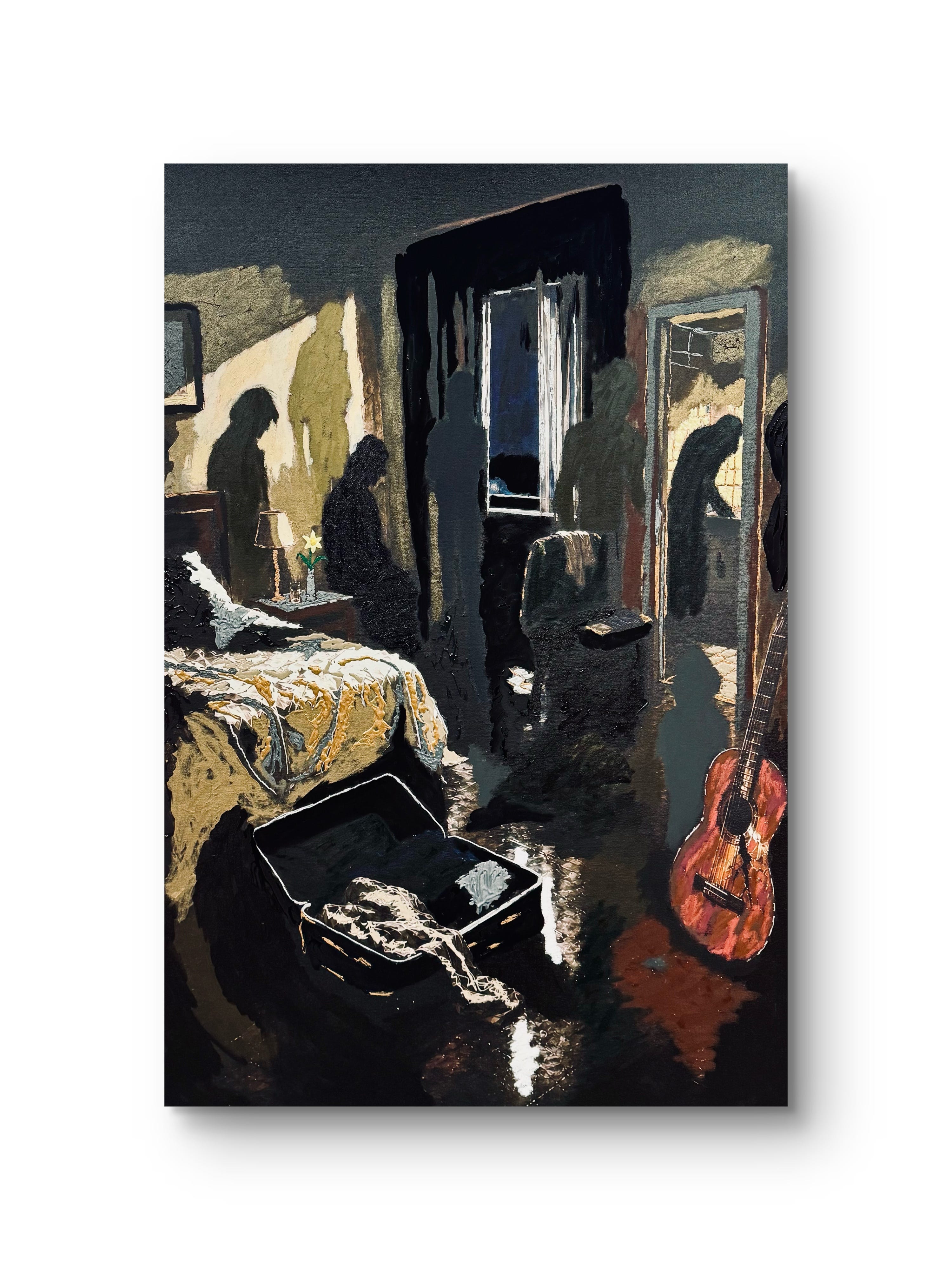
On the bedside table rests a daffodil—the last daffodil on Earth—a silent witness softly singing a ballad about how much pain a soul can conceal before the light within it finally departs.
19.Never Grow Old
The nineteenth canvas in The Daffodil Lament marks the moment I postponed for the longest time: Dolores O’Riordan’s departure from our world.
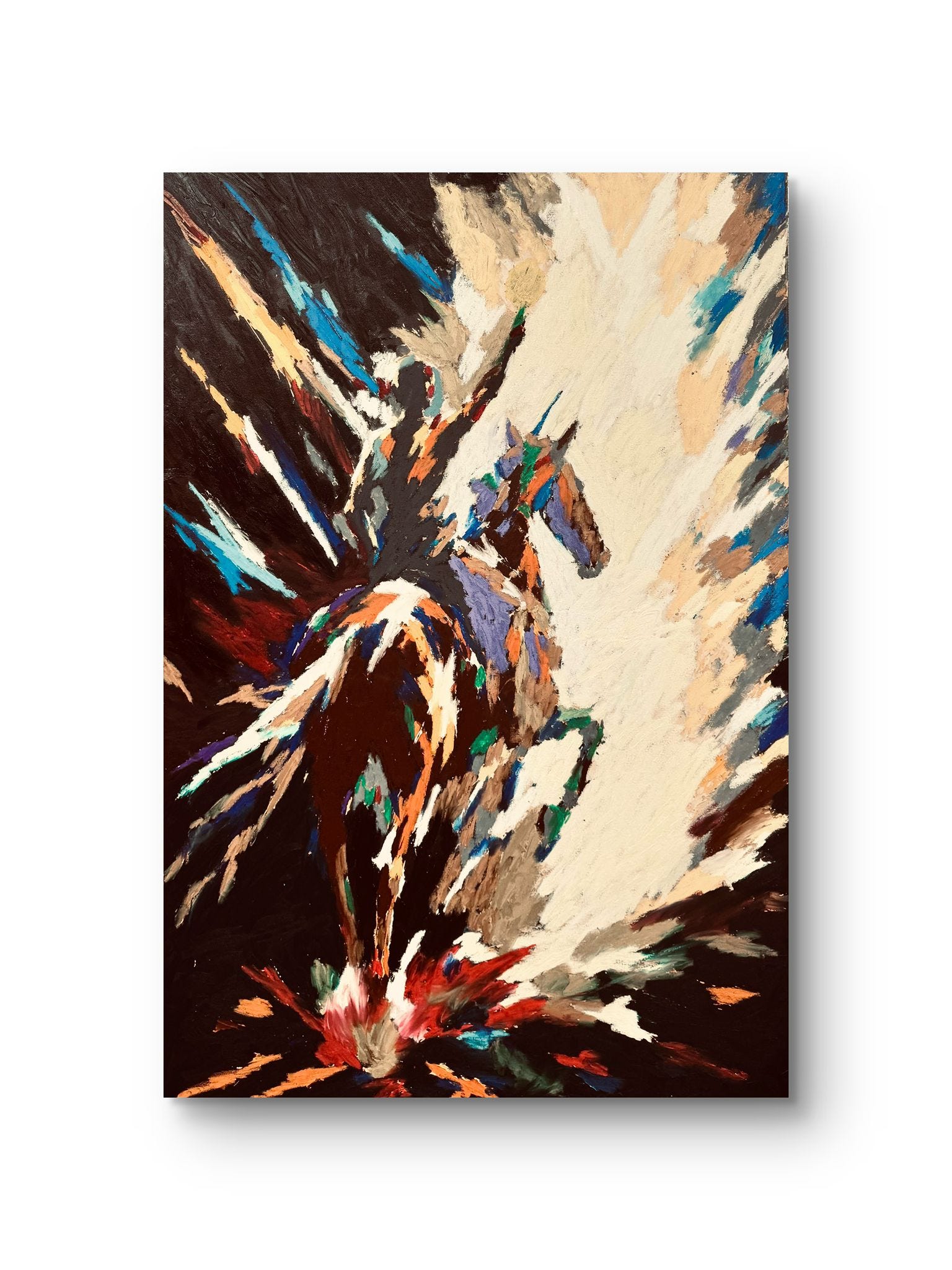
I chose to title this work Never Grow Old not because the song is about the perfect day to die or the fear of growing old, but because its true message is something far more profound: remain forever young in your mind and in your heart, no matter what the passing years do to your body.
In my painting, Dolores does not die. She triumphantly crosses the magical threshold we all fear. And to make that journey, she needs neither raven nor mystical jackal to guide her into the Beyond. She has her own psychopomp—a fearless horse carrying her safely through the knotted reins of the World.
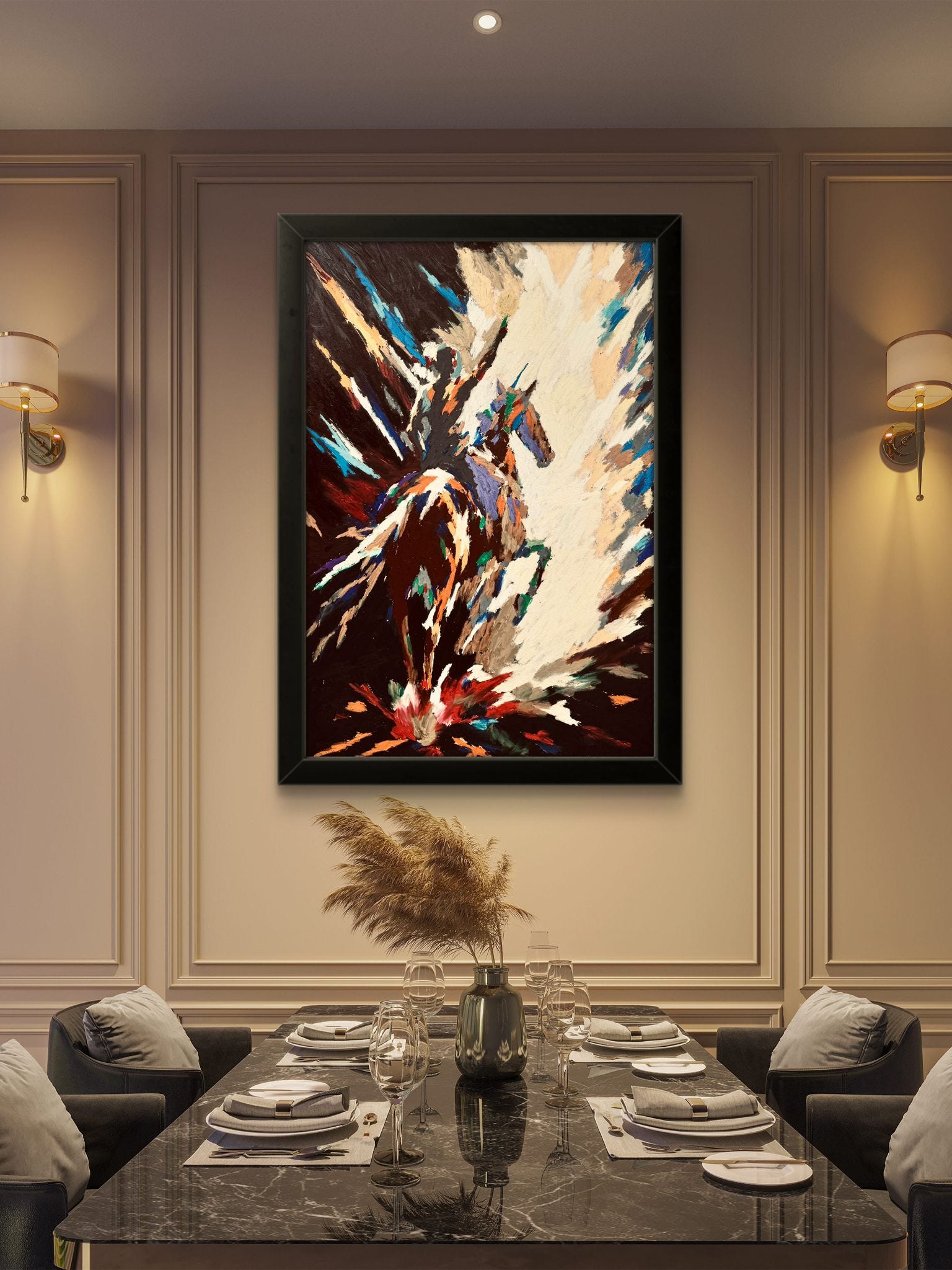
Dolores needs no coin to earn Charon’s passage. With the delicate daffodil in her hand, she shatters Death itself in an almost liturgical gesture.
After eighteen works about pain, love, and loss, this is the first in which I no longer look back. I let Dolores walk forward, carrying a single daffodil in her hand.
All that remains with me are her songs.
20.Wake me when it’s over
The performance is over, yet the curtain has forgotten to fall. In this twentieth chapter of The Daffodil Lament series—the penultimate of the twenty-one works I set out to create—the space is no longer merely a backdrop but a monumental amphitheater, an abandoned temple of oblivion now submerged in absolute silence. The endless rows of empty seats become the crosses of a collective absence—a cemetery of memory where the audience has turned into shadows, and the music has been replaced by the weight of darkness.
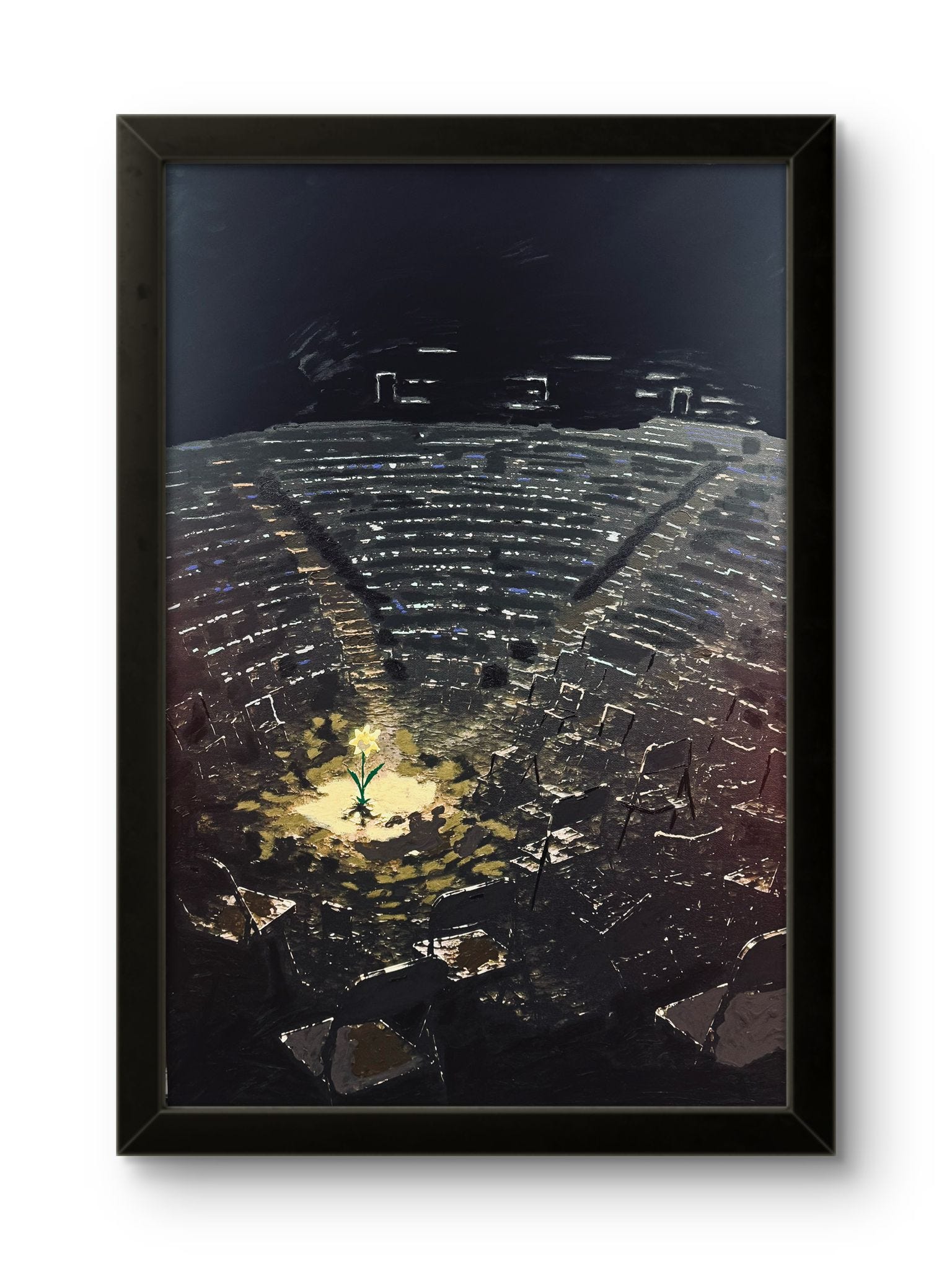
Within this vast emptiness, the center of the stage is claimed by an unexpected presence: a solitary daffodil rising through the cracks of reality, bathed in a golden concert light that seems to pulse in dissonance with the silence of the hall. It is a brutal antithesis—the biological fragility of the daffodil set against the cold, metallic austerity of the amphitheater. Yet to me, it is the true victory of an artist who has left tangible traces upon the Earth.

Wake Me When It’s Over is about suspension. I wanted to freeze on canvas that moment between breaths, between the disappearance of the audience and the emergence of a new order. No one can buy a ticket to this concert of solitude anymore, yet all of us can still listen to Dolores’ daffodil voice.
21.A place I know
A Place I Know is the twenty-first and final canvas in The Daffodil Lament, the series I have dedicated to Dolores O’Riordan, the voice of The Cranberries.
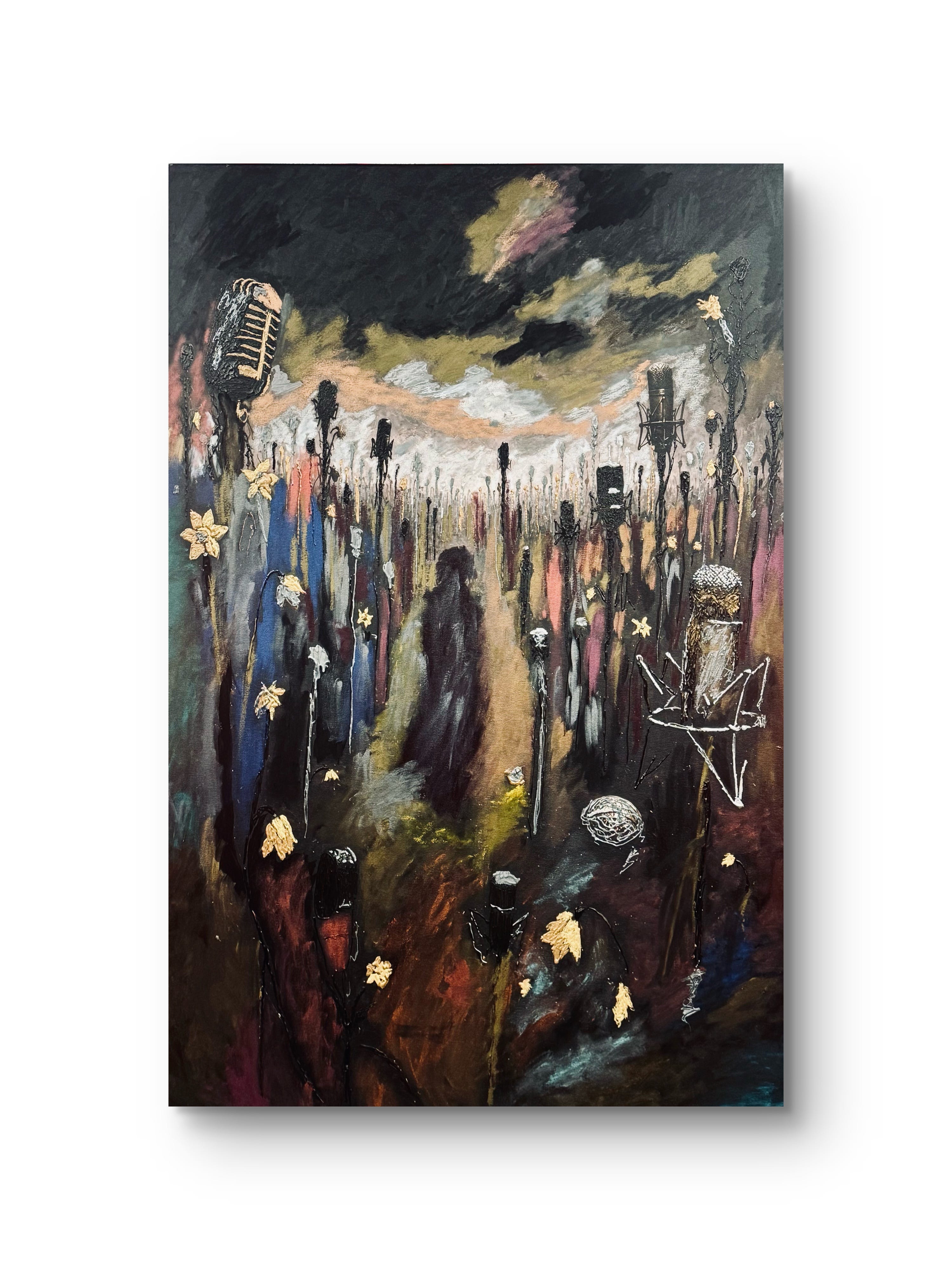
It has been exactly ninety days since I began this artistic journey dedicated to the fragility of the human soul, guided by Dolores’ songs and emotions.
I spent those days in my garage, singing her songs like a madman as I painted. I cried while I painted. For a while, I became Dolores.
I think you felt it too.
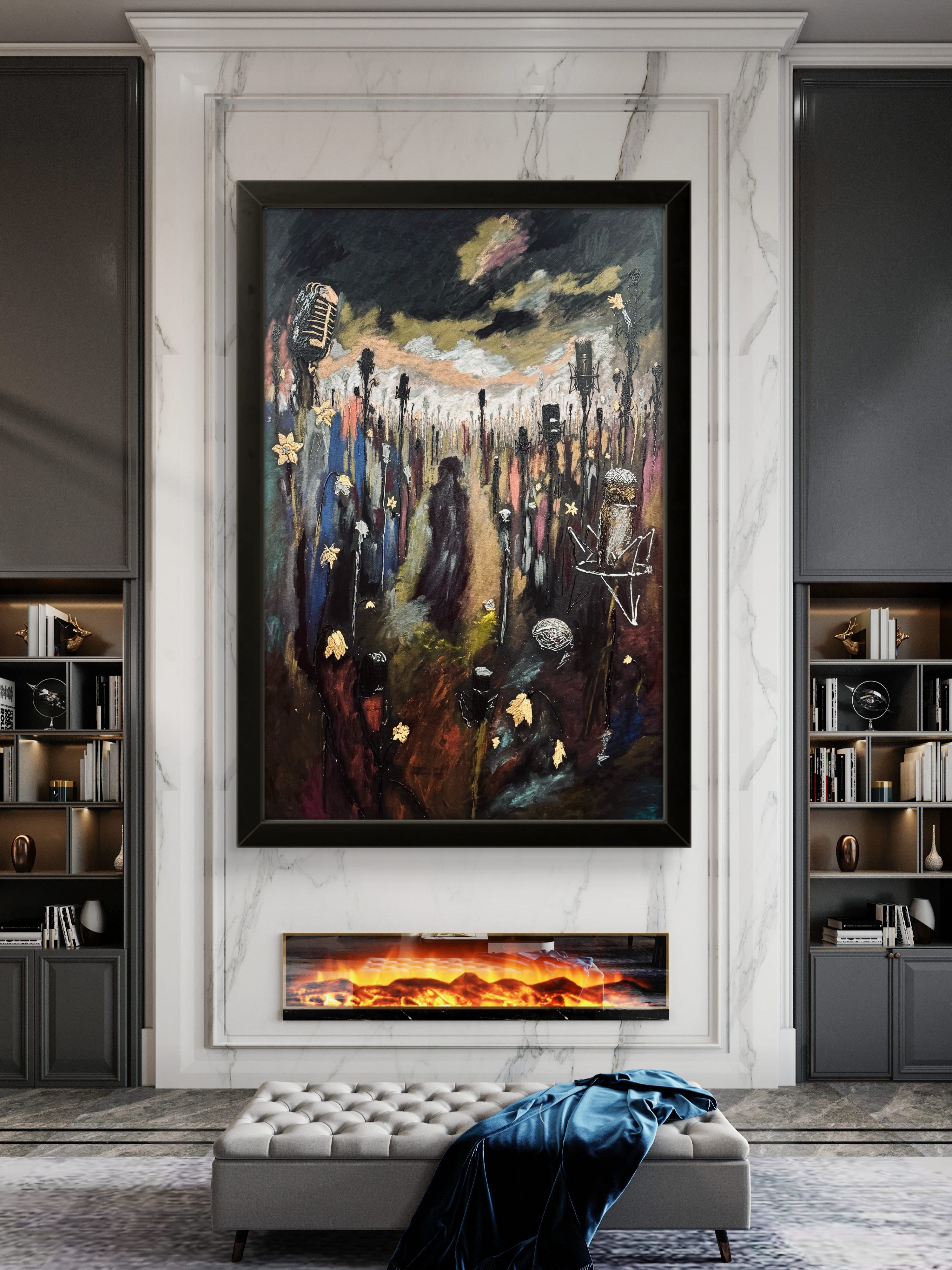
Together, we retraced the journey of her life, a life marked by constant battles—an almost live experiment in which you became witnesses to my own journey with my fingers and my brush.
I feel that I accomplished what I set out to do, and I am proud. Proud that I began it, that I stayed with it, and that I brought the series to its perfect conclusion.
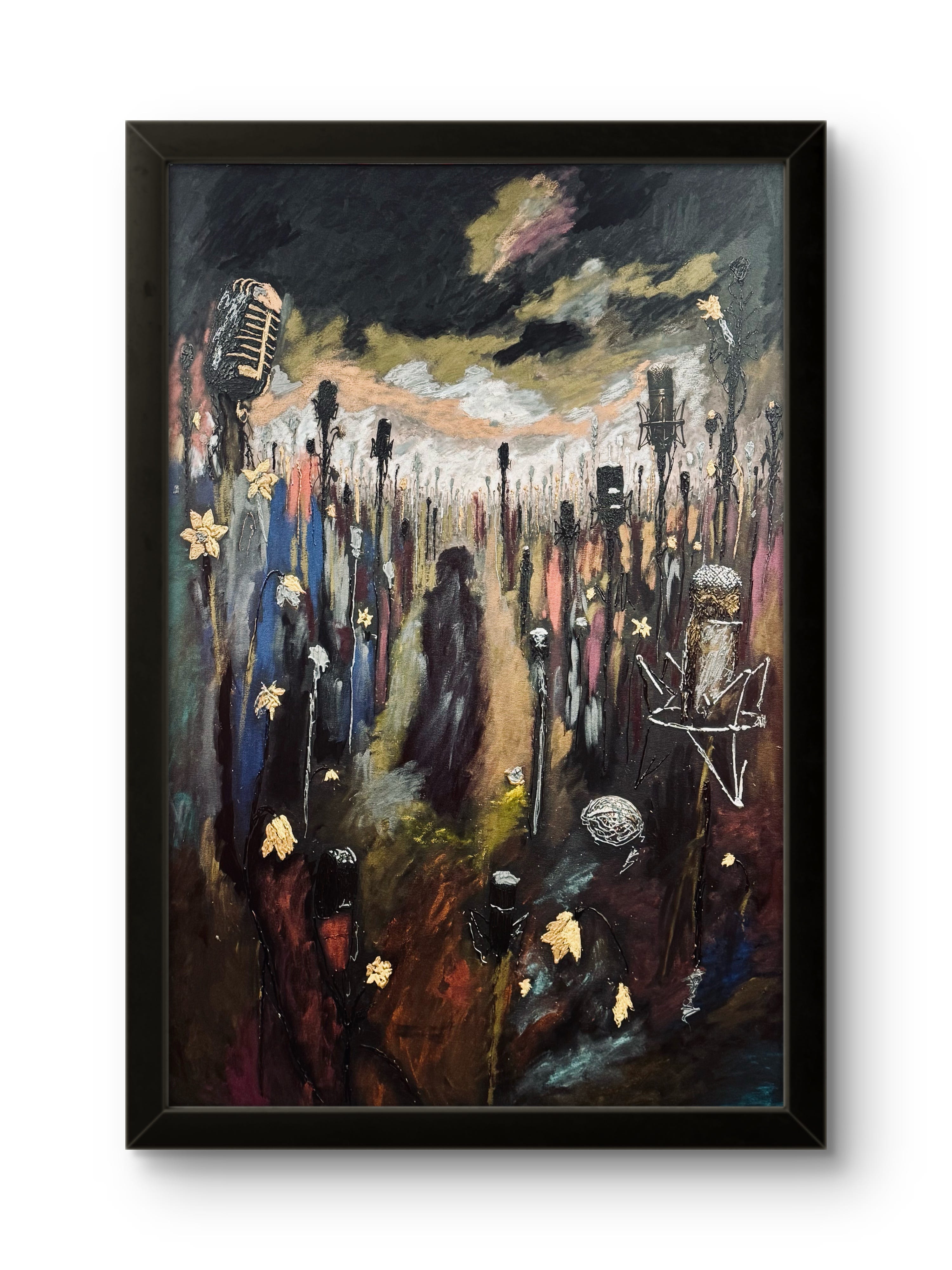
A Place I Know is Dolores’ strange song, one that seemed to tell us, even back then, where she would one day arrive. Look closely. It is a place unlike any you have ever seen, born from my imagination, yet I am certain it exists—a peaceful, endless field from whose soil microphones and daffodils grow.
Dolores walks among them, gliding gently through the landscape, where there is no need for wings, no need for dreams.
There is only silence.
Silence.
Silence sometimes sounds so loud and really hurts !